The Best Heavy Duty Dog Crates (2026)
Escape-proof steel dog crates compared on frame gauge, lock design and mobility, plus the honest point that no crate fixes the anxiety behind it.
A heavy duty crate is bought for one of two reasons: a dog that has already destroyed a wire crate, or a dog large enough that a standard crate was never going to hold it. Those are different problems, and only one of them is solved by buying more steel.
What we scored
Build, cleaning, durability, pet fit and value. Build and durability dominate, and both come down to two things a listing rarely states plainly: the gauge of the tubing and whether the corners are welded or bolted. Bolted corners are where a determined dog eventually finds play.
Latches, and where they sit
A single slide bolt is not a lock, it is a puzzle with one step. The crates worth buying use two independent latches, positioned so a dog cannot reach them through the bars with a paw or work them with its nose.
Placement matters as much as the mechanism. A well-made latch mounted where the dog can get at it is a latch the dog will get at, given enough unsupervised hours.
Size, and the mistake of going too big
Big enough to stand without ducking, turn around and lie fully stretched. Beyond that, extra space is not a kindness for a crate-trained dog, and in a very large cage a big dog has room to build momentum against the door, which is how doors bend.
Measure nose to tail base, add about four inches, and measure standing height to the top of the head rather than the shoulder.
The thing a stronger crate does not fix
If your dog is breaking out of crates, the crate is the symptom. Dogs that panic in confinement have broken teeth, torn nails and injured their mouths trying to escape steel, and a stronger cage makes that outcome more likely rather than less, because it does not yield.
Destruction from boredom is a training and enrichment problem. Destruction accompanied by drooling, howling, or self-injury is separation distress, and that is a conversation with a vet or a qualified behaviourist. We review products and are not veterinarians or behaviourists.
Living with one
Put a mat or plywood under it from the start, both for your floor and for the noise, which a steel crate on a hard floor amplifies considerably.
Comfort inside matters too, and a bare metal tray is not somewhere a dog will settle. Our best orthopedic dog beds roundup covers the flat mattresses that fit a crate floor properly, and best dog beds for senior dogs is the better page if the dog using the crate is older and stiff.
How we test
Every pick is scored on the same five criteria and cross-checked against real owner feedback - so the ranking reflects how a product holds up after six months in a real house with a real animal, not its spec sheet.
Build
Materials and construction: pump and motor quality, whether plastics are food safe, and how well the thing is actually put together.
Cleaning
How much work it is to keep hygienic. Dishwasher-safe parts, how many pieces it breaks into, and whether biofilm can hide in a corner you cannot reach.
Durability
Whether it survives months of daily use, chewing, scratching and repeated washing without the motor dying or the seals failing.
Pet fit
Whether animals will actually use it: size range, whisker clearance, height, and how the design suits nervous or senior pets.
Value
What you get for the price, including the running cost of filters, liners and other consumables it locks you into.
Best overall
LEMBERI 48 inch Heavy Duty Dog Crate
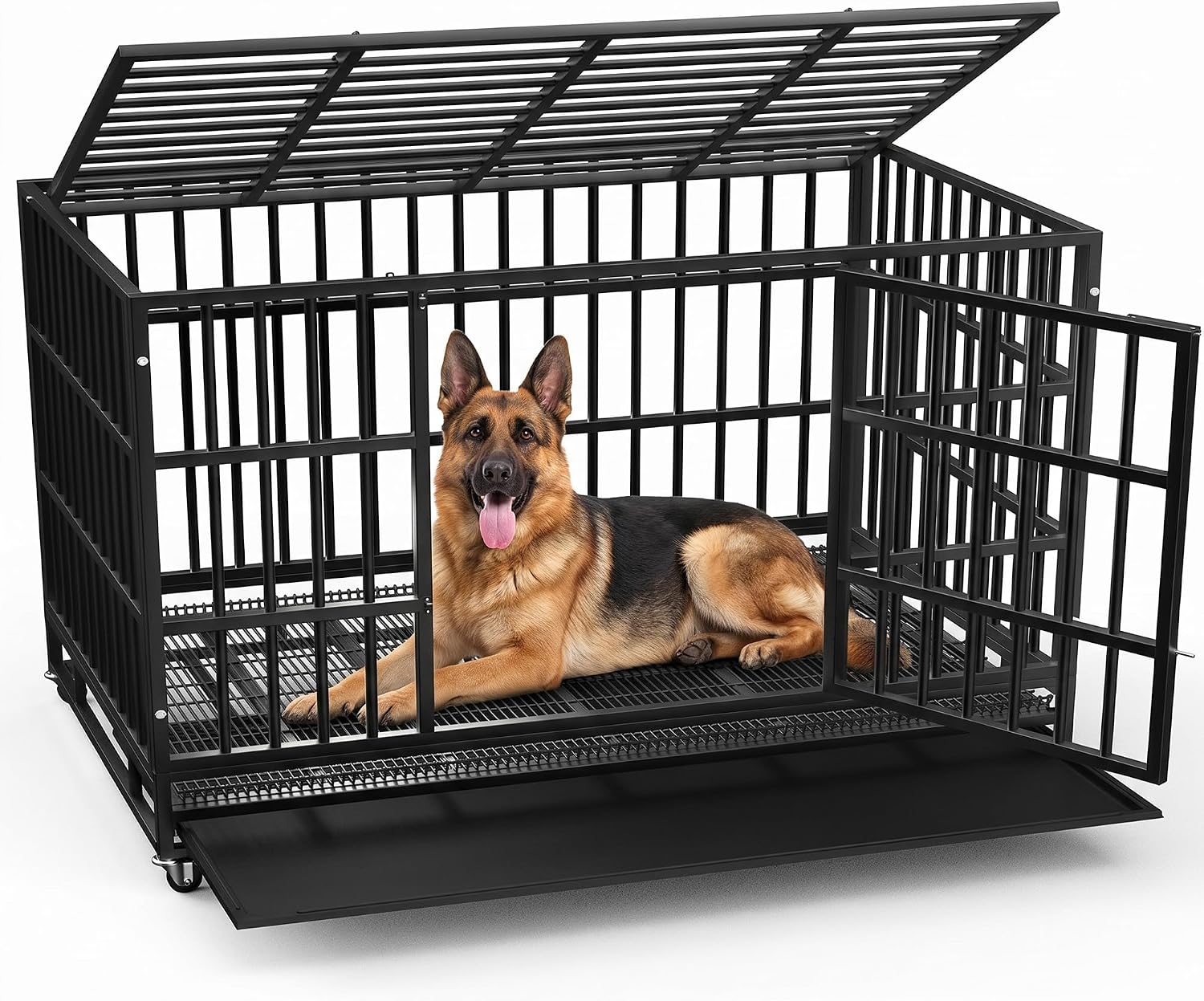
The most convincing balance of frame strength, lock design and price here. The tubing is genuinely heavy gauge rather than thin steel finished to look tough, the welds at the corners are clean, and it uses two separate latches positioned out of easy reach. The 48-inch size suits a german shepherd or a labrador with room to stand and turn. It ships flat and assembly is a two-person job for about half an hour, and like every crate here it is heavy enough to want a mat underneath on a wood floor.
Pros
- Heavy gauge tubing with clean corner welds
- Two independent latches, placed out of reach
- Sized properly for a large breed
- Lockable casters for moving it
Cons
- Two-person assembly, around half an hour
- Needs floor protection underneath
Best welds
Hiwokk 48 inch Heavy Duty Dog Crate
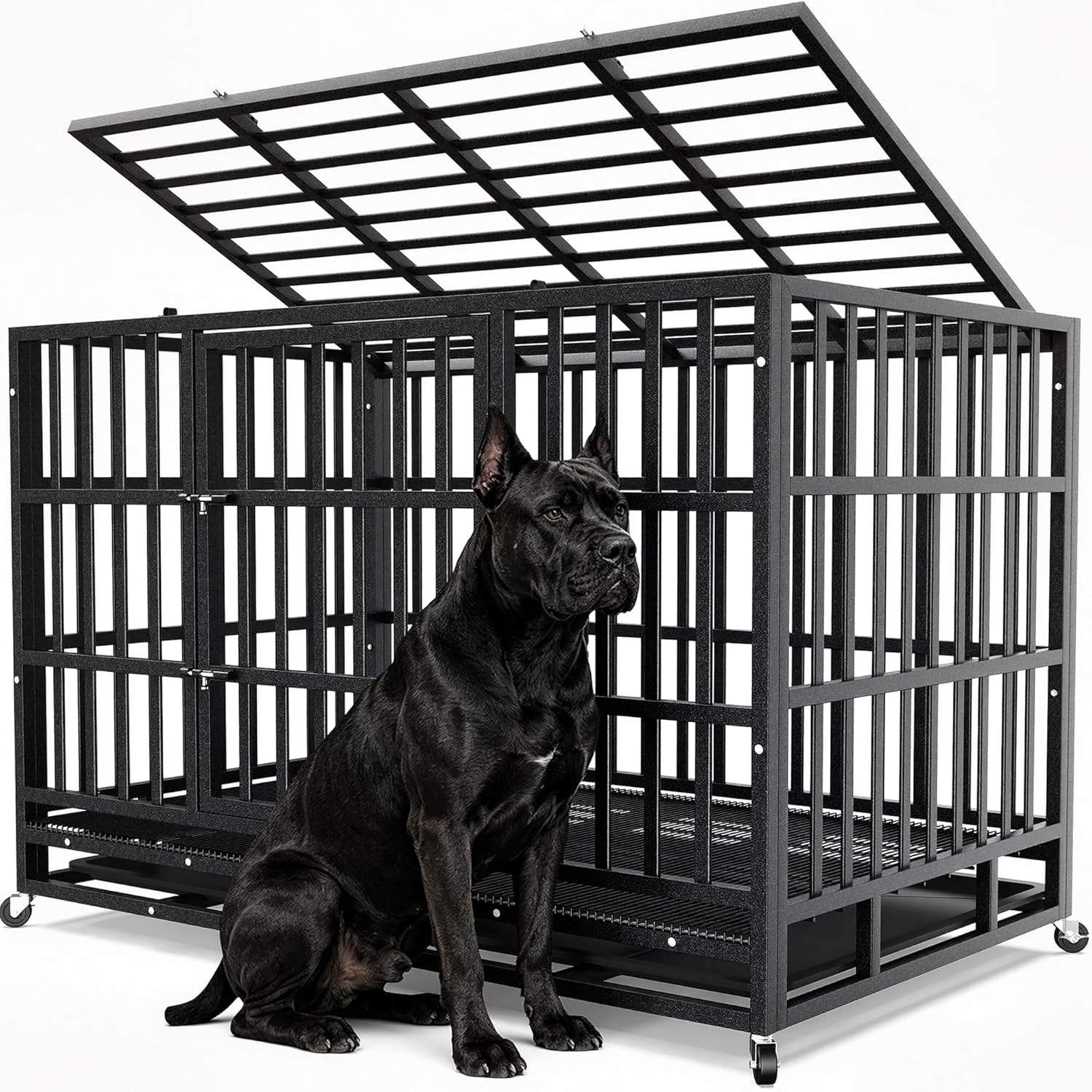
The one to buy if a previous crate failed at a joint rather than at a latch, which is how most of them actually go. The frame is fully welded at the stress points instead of relying on bolted corner brackets, and bolted corners are where a dog working steadily at one spot eventually finds play. It is correspondingly heavy and awkward to move even on its casters. A smaller review base than the LEMBERI, so less long-term evidence, but the construction is visibly the more serious of the two.
Pros
- Welded rather than bolted at the stress points
- Very rigid once assembled
- Removable tray for cleaning
Cons
- Heavy and awkward to reposition
- Smaller review base than our top pick
Best mid-size
LUCKUP 38 inch Heavy Duty Dog Cage
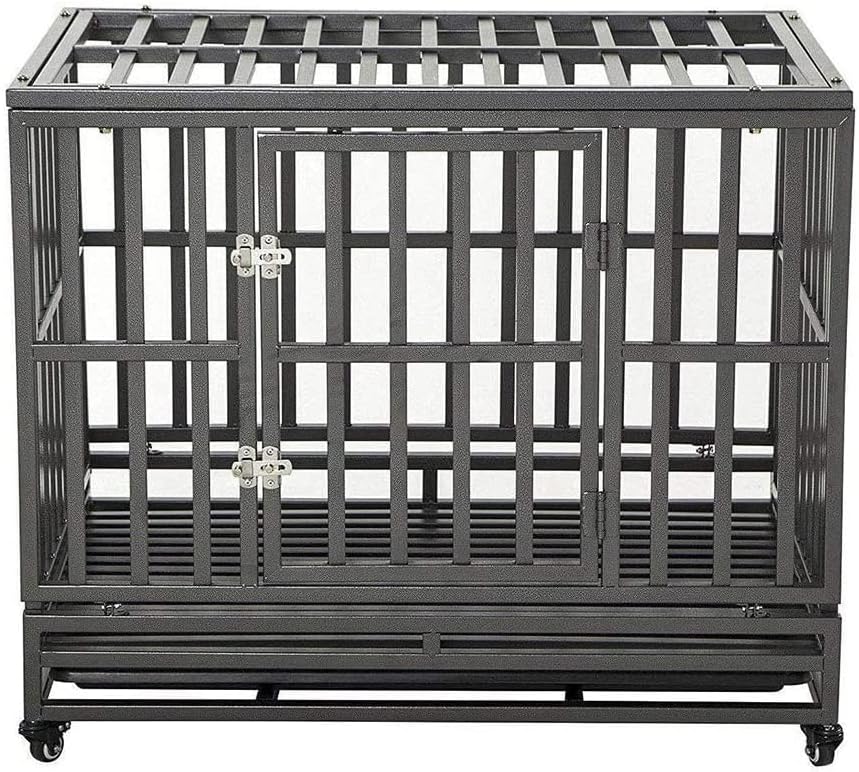
The pick for a dog that needs a strong crate but not a 48-inch one, which is a real gap: most heavy duty crates are sold for giant breeds and a 30-kilo dog in an oversized cage has room to build momentum against the door. At 38 inches this fits a bulldog, a staffie or a springer properly. Build quality is a step below the LEMBERI, with bolted rather than welded corners, and on four thousand reviews it is well evidenced at the price.
Pros
- Fills the mid-size gap in this category
- Well evidenced for the price
- Two-door access
Cons
- Bolted corners rather than welded
- Tray is thinner than the premium crates
Best mobility
KOKOTANGS 42 inch Heavy Duty Dog Crate
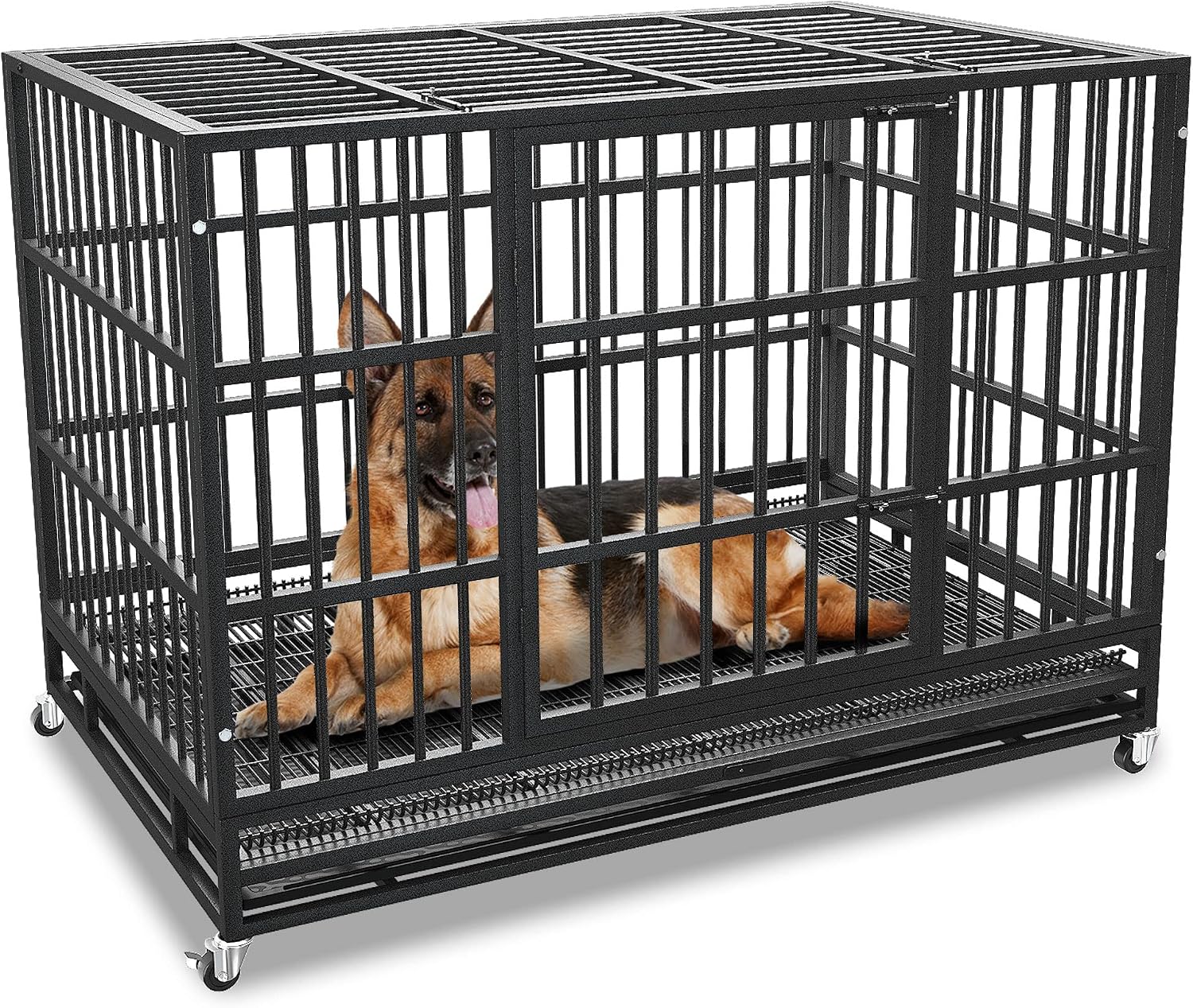
Built around actually moving the thing, which matters more than buyers expect: a crate that lives in the kitchen on weekdays and the utility room at weekends is otherwise a two-person lift every time. The casters are larger than the others here and lock properly, and the tray slides out from the side rather than needing the crate lifted. At 42 inches it splits the difference between the mid-size and large options. The extra mobility means slightly more flex in the frame than the welded Hiwokk.
Pros
- Large lockable casters that genuinely roll
- Side-sliding tray, no lifting to clean
- Useful 42-inch middle size
Cons
- Slightly more frame flex than the welded designs
- Casters raise the height, so check doorways
Best value at size
Feandrea 48 inch Heavy Duty Dog Crate
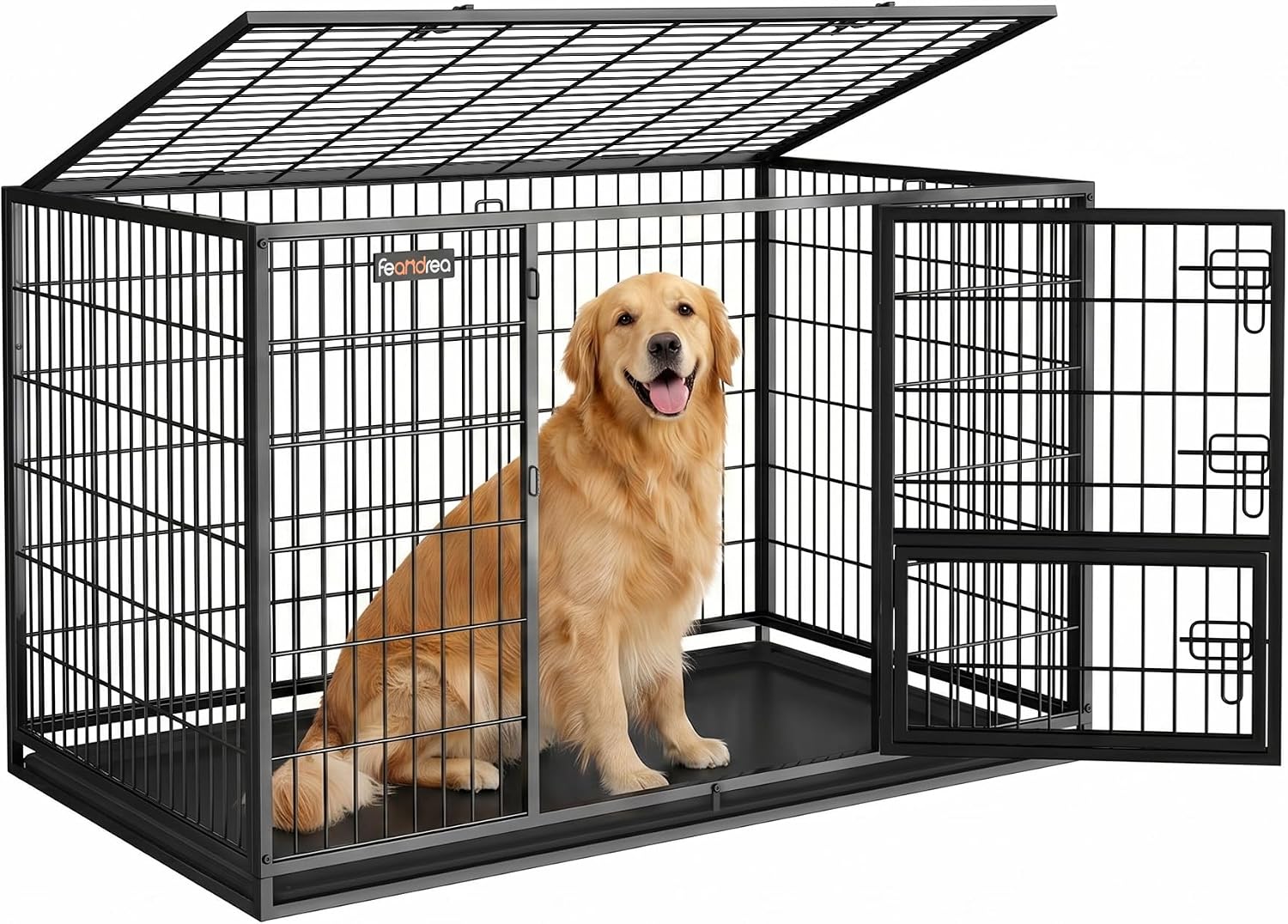
The cheapest way into a genuine 48-inch steel crate from a brand with a real support presence, which counts for something when a part arrives bent or a caster is missing. The frame is adequate rather than exceptional and the latches are the standard two-point arrangement. For a large dog that needs containment while you are out but is not actively attacking the crate, this is enough, and the money saved is better spent on the behaviour work than on gauge you will not use.
Pros
- Lowest price for a genuine 48-inch steel crate
- Established brand with real support
- Standard two-point latching
Cons
- Frame gauge is adequate rather than exceptional
- Not the one for a dog that actively attacks a crate
Also worth considering
Strong, well-reviewed products that just missed our ranked list - worth a look if the picks above aren't quite right for you.
- SHUSHIM 48 inch Heavy Duty Crate with Wheels - A high-anxiety focused design with wheels and a strong latch set, worth checking if our mobility pick is unavailable.
- BOLDBONE 38 inch Escape-Proof Dog Crate - A well-rated mid-size crate with a smaller review base, a reasonable alternative to the LUCKUP.
- LUCKUP 42 inch Heavy Duty Crate, two doors - The larger LUCKUP with a second door, useful where the crate has to sit against a wall.
Frequently asked questions
What actually makes a crate escape proof?
Two things, and neither is the marketing word on the box. First, the locks: two independent latches placed where a dog cannot reach them with a paw or a nose, rather than one slide bolt. Second, the joints, because determined dogs work at the corners rather than the bars. Weld quality and tube gauge decide whether a crate lasts, and a thin-gauge cage with a good lock simply bends open somewhere else.
Will a heavy duty crate stop separation anxiety?
No, and this is worth being blunt about. A stronger crate contains a dog that panics; it does not stop the panic, and dogs have injured themselves badly trying to escape one. If your dog is destroying crates, drooling, or is distressed rather than merely bored, that is a behaviour problem to work on with a vet or a qualified behaviourist. Use the crate for safety in the meantime, not as the solution.
What size should I buy?
Big enough to stand without ducking, turn around, and lie fully stretched out. Measure the dog from nose to tail base and add about four inches for length, and measure from floor to the top of the head while standing for height. Bigger is not automatically better for a dog that likes a den, but too small is a welfare problem and the commonest sizing error.
Are wheels worth having?
If the crate ever moves, yes, because these weigh 50 to 100 pounds empty and dragging one across a floor damages both. Look for lockable casters, and check they lock, because an unlocked wheel under a dog that throws itself around turns the whole crate into a moving object.
Will it damage my floors?
Very likely on wood or vinyl without protection, from the weight and from the tray edges. Put a rubber mat or plywood underneath from day one rather than after you find the marks. It also cuts noise considerably, since a steel crate on a hard floor amplifies every movement the dog makes.