PETLIBRO vs PetSafe Cat Feeder (2026): Which Should You Buy?
PETLIBRO Granary WiFi versus PetSafe Simply Feed: portion precision, hopper size, what actually jams an auger, and which one survives losing its app.
These two dominate the automatic feeder shortlists, and the comparison is usually framed as app versus no app. That framing is backwards. The app is a symptom of the real difference, which is what each company decided a feeder is for.
They are not the same machine
The PETLIBRO is a scheduler with a hopper. The PetSafe is a portioning machine that happens to run on a timer. That shows up in the mechanism: PETLIBRO uses an auger, PetSafe a rotating carousel of fixed compartments. The auger is why the PETLIBRO can do ten meals a day at arbitrary sizes, and the carousel is why the PetSafe can put down an eighth of a cup accurately when the auger cannot.
Neither is better in the abstract. One is better for your cat.
What actually goes wrong in month three
Feeders do not usually die. They stall, and almost always on kibble shape rather than on any fault of their own. Large, triangular or irregular pieces bridge across an auger throat and hang there, so the motor turns and nothing falls. The PETLIBRO’s throat is wider than most and copes with more shapes. The PetSafe has no throat to bridge, which is a structural advantage rather than a tuned one.
The second failure is quieter and takes longer. A connected feeder is only as durable as the vendor’s commitment to running the service behind it. The PETLIBRO handles this better than most, because schedules are stored on the device and it keeps feeding through an outage. But the app is still a dependency that the PetSafe simply does not have, and over a five year ownership window that asymmetry is real. It is also the reason our main feeder roundup keeps a no-WiFi model on the list.
The portion question decides most purchases
If a vet has raised your cat’s weight, buy the PetSafe. An eighth of a cup is a meaningful increment on a cat eating a third of a cup a day, and the PETLIBRO cannot match it. Slow-feed mode matters too, for a specific and common problem: a cat that eats too fast and returns the meal to the carpet ten minutes later.
If weight is not the issue, the PETLIBRO’s advantages are the ones you will actually notice, mostly the low-food sensor and being able to confirm from work that the cat was fed.
Noise is underrated
The PetSafe is louder, and the reviews under-report how much this matters because owners judge it and cats experience it. A nervous cat that associates a loud clunk with food will still eat, but often only once the room is empty. If your cat already avoids the washing machine, take the noise difference seriously.
Which to buy
Buy the PetSafe if your cat is on a weight plan, eats too fast, has an awkward kibble, or if you want the fewest possible dependencies. Buy the PETLIBRO for everything else, particularly if you are out of the house at feeding times and want to know a meal landed.
Neither takes filters or cartridges, so unlike a cat water fountain, the purchase price is close to the whole cost. That is the one thing this category gets right.
How we test
Every pick is scored on the same five criteria and cross-checked against real owner feedback - so the ranking reflects how a product holds up after six months in a real house with a real animal, not its spec sheet.
Build
Materials and construction: pump and motor quality, whether plastics are food safe, and how well the thing is actually put together.
Cleaning
How much work it is to keep hygienic. Dishwasher-safe parts, how many pieces it breaks into, and whether biofilm can hide in a corner you cannot reach.
Durability
Whether it survives months of daily use, chewing, scratching and repeated washing without the motor dying or the seals failing.
Pet fit
Whether animals will actually use it: size range, whisker clearance, height, and how the design suits nervous or senior pets.
Value
What you get for the price, including the running cost of filters, liners and other consumables it locks you into.
Better for most cats
PETLIBRO Granary WiFi Automatic Cat Feeder
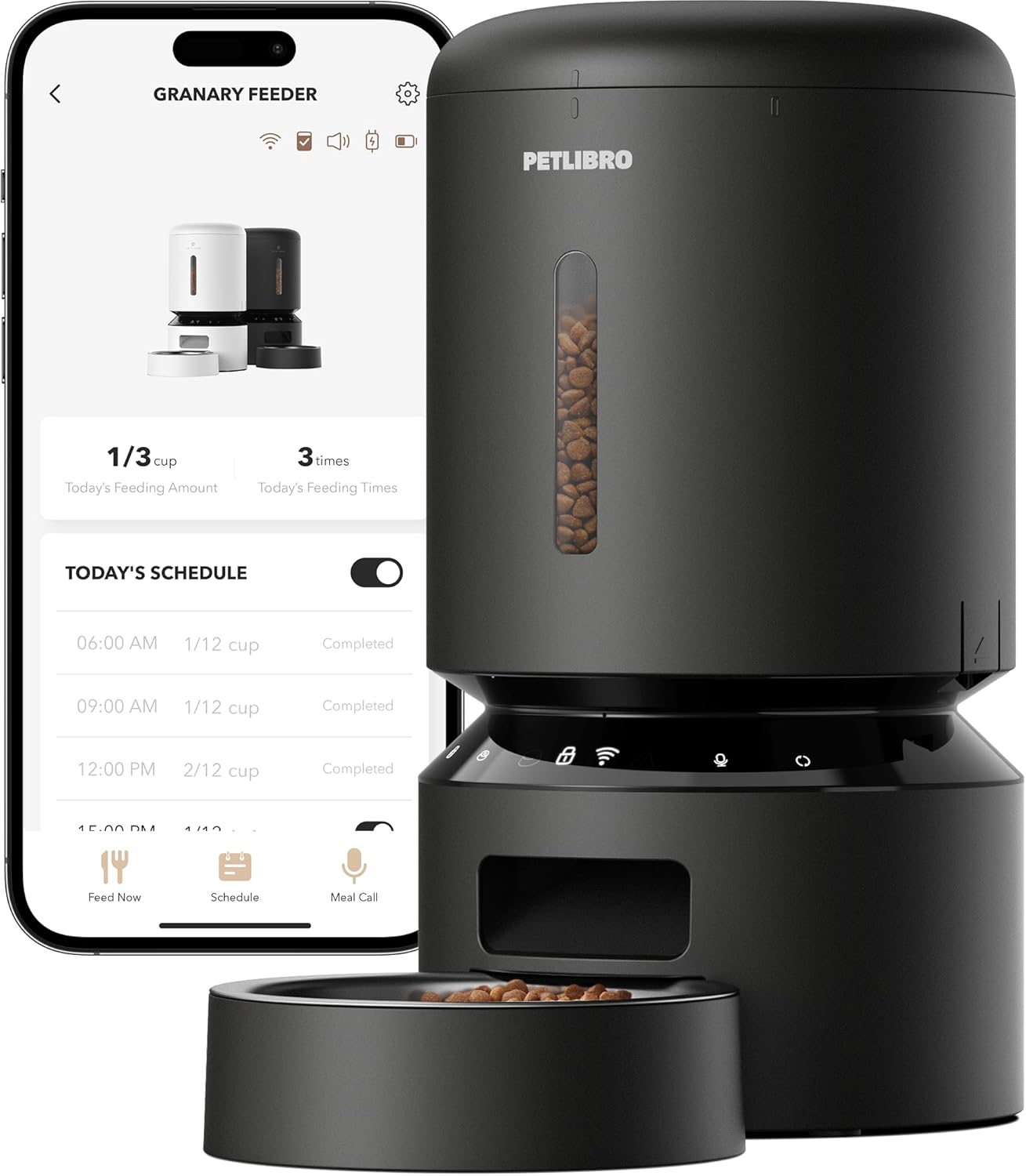
The one to buy if your cat eats normal portions on a normal schedule and you want to see that it happened. The 5L hopper and wide anti-blockage throat handle more kibble shapes than most, the low-food sensor warns you before the bowl comes up empty, and up to ten meals a day suits a cat that does better on six small ones than two large. Crucially the schedule lives on the device, so a WiFi dropout costs you notifications rather than meals. At 4.2 stars across ten thousand reviews the complaints cluster on setup and connectivity, not on the mechanism, which is the better place for complaints to sit.
Pros
- Wide anti-blockage throat handles more kibble shapes than most
- Low-food sensor warns you before the hopper runs dry
- Keeps its schedule locally when WiFi drops
- Stainless bowl lifts out; hopper stays in place
Cons
- WiFi setup is the most common source of frustration in reviews
- Needs an account and an app you cannot skip
Better for portion control
PetSafe Healthy Pet Simply Feed
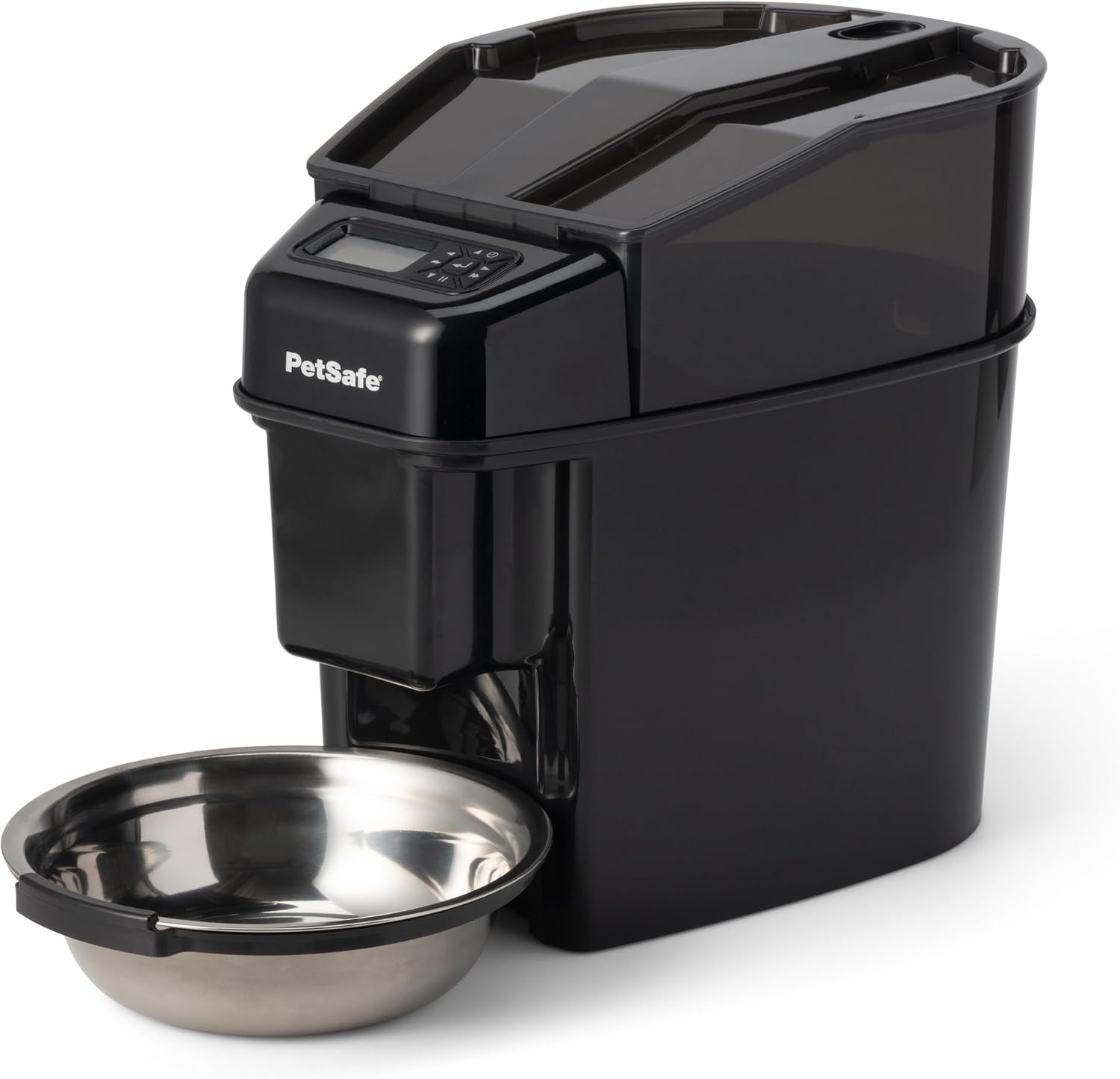
The one to buy if the word overweight has come up at the vet, or if you simply do not want a feeder that has opinions about your home network. Portions run from an eighth of a cup to four cups across twelve meals, finer than anything else in this category, and slow-feed mode spreads one meal over fifteen minutes to stop a fast eater bringing it back up. The 24 cup hopper is the largest here. There is no app, which is the point rather than an omission: fewer parts, fewer dependencies, nothing to deprecate. Every food-contact part is dishwasher safe. It is bulky and the mechanism is audibly louder, which bothers nervous cats more than owners expect.
Pros
- Finest portion control here, from an eighth of a cup upward
- Slow-feed mode spreads one meal over fifteen minutes
- 24 cup hopper, the largest of the two by a wide margin
- All food-contact parts are dishwasher safe
- No app, no account, nothing to deprecate
Cons
- Noticeably louder mechanism than the PETLIBRO
- Bulky, and no remote control at all
Also worth considering
Strong, well-reviewed products that just missed our ranked list - worth a look if the picks above aren't quite right for you.
- PETLIBRO Granary Automatic Cat Feeder (no WiFi) - The same hopper and throat as our top pick with the radio removed. The honest choice if you want PETLIBRO's mechanism without an account.
- Cat Mate C500 - Five compartments with ice packs, so it handles wet food, which neither dry-only feeder here can do at all.
- Cat Mate C3000 - A three-day dry feeder with no electronics beyond a timer. Cheap, and the least there is to break.
Frequently asked questions
Which one jams less?
Neither jams often, and when either does it is almost always the kibble rather than the feeder. Augers stall on large, irregular or triangular pieces that bridge across the throat instead of falling through it. The PETLIBRO has the wider anti-blockage throat and copes with more shapes; the PetSafe uses a rotating carousel rather than an auger, so there is no throat to bridge at all. If your cat eats an awkwardly shaped kibble, the PetSafe is the safer mechanism.
What happens when the WiFi drops?
The PETLIBRO keeps feeding. Schedules are stored on the device, so a dropped connection costs you the app and the notifications, not the meals. This is the single most misread thing about connected feeders, and it is worth checking on any model you consider: a feeder that needs the cloud to dispense is a feeder that stops when the vendor's server does.
Which is better if my vet said to put the cat on a diet?
The PetSafe, without much argument. It portions from an eighth of a cup upward across twelve meals, finer than the PETLIBRO, and its slow-feed mode spreads one meal over fifteen minutes so a fast eater does not inhale it and bring it straight back up. Weight work is where precision beats connectivity.
Is the app worth paying for?
Only if you will genuinely use remote feeding or intake logging. If you want the machine to put down the same portions at the same times every day, the app is a second thing that can break for a benefit you were never going to use. Buy the feeder that matches the job, not the one with more features.
Do either of them have running costs?
No, and that is worth knowing if you are coming from a fountain. Neither takes filters, cartridges or any other consumable, so the purchase price is close to the whole cost. Budget for batteries as a power-cut backup and nothing else.