The Best Cat Water Fountains (2026): Tested on Month Three, Not Day One
Cat water fountains from Catit, PETKIT, PetSafe and PETLIBRO, compared on pump life, biofilm and what the filters really cost per year.
Every fountain on the market looks good on day one. The interesting question is what it looks like in month three, when the pump has started to whine, the filter is overdue, and something has gone slightly slimy inside a channel you cannot get a brush into.
That is what this ranking is built around. We weighted three things far more heavily than a spec sheet would: how the pump is engineered and therefore how long it will live, how many pieces the thing breaks into for cleaning, and what the filters cost per year once you are locked in. Everything else is secondary, because a fountain that is annoying to clean stops getting cleaned, and a fountain that stops getting cleaned ends up in a cupboard.
Why pumps fail, and why it decides this ranking
The failure that ends most fountains is not dramatic. A cheap brushed DC motor runs continuously, grease works its way out of the bearing over a few months, the impeller shaft starts to contact its housing, and you get a rattle or a whine. Owners report this clustering around the four to eight month mark, and running the reservoir dry brings it forward sharply.
This is why the wireless-pump models score so well on build and durability despite costing more: an inductive pump has no brushes and no contact friction, and a motion sensor lets a battery model idle when the room is empty. It is also why capacity matters. A larger reservoir is insurance against the pump running dry while you are at work.
The Catit still leads this list because the evidence behind it is unmatched and it is where most households should start. If you already know your cat uses a fountain and want the inductive-pump design at its best, our PETLIBRO Dockstream review covers the cordless model we rate most highly.
Stainless steel is a claim worth checking
“Stainless steel fountain” is doing a lot of work in this category’s marketing. Several popular models are a steel top plate sitting on an entirely plastic reservoir and a plastic pump housing. That is not nothing, since the surface your cat’s chin touches is the one that matters most for feline chin acne, but it is not the product the listing implies.
Plastic is not disqualifying, and the Catit proves it. Plastic simply scratches, scratches hold biofilm, and biofilm is why a fountain smells faintly wrong two days after cleaning. If you go plastic, clean it more often and replace the bowl, not the pump, once it looks cloudy.
Whisker fit is a real thing, and it is why some cats refuse
A cat that approaches, hesitates and walks away is often not rejecting the water. Narrow, deep bowls press on the whiskers, and plenty of cats will not tolerate that. It is the first thing to check when a fountain is ignored, and every pick here has a bowl wide enough to avoid it.
The other common reason for refusal is noise, particularly with a nervous cat. Start on the lowest flow setting for the first week. A fountain that trickles is far more likely to be accepted than one that splashes.
What we checked and what we rejected
Several fountains that appear on most other lists did not make this one. The Pioneer Pet Raindrop stainless steel fountain sits at 3.9 stars across more than eight thousand reviews, which is below our 4.0 floor, and the complaints are pump noise rather than anything trivial. PETLIBRO’s stainless Capsule is also at 3.9 and had no working buy box when we checked.
The stainless Veken dropped out in September 2026: none of its colour options could be bought through Amazon when we checked, and a pick you cannot buy is no pick at all. The plastic Veken remains available, and our Veken fountain review covers it in full.
There are no honorable mentions on this page for the same reason. Every candidate we checked either failed the rating floor or could not be confirmed as buyable, and an empty list is more useful to you than links that may be dead.
Living with a fountain
If the same cat is on a scheduled diet, our best automatic cat feeders roundup covers the other half. Veken vs PETLIBRO settles the usual cheap-versus-premium cross-shop. Set a fortnightly reminder for the pump, not just the bowl. Pull the impeller out, brush the housing, and put it back. That one habit is the difference between a fountain that lasts two years and one that lasts five, and it is the step nearly everyone skips.
The same introduction rule governs a self cleaning litter box: keep the old still-water bowl, and the old tray, out for at least a fortnight. Cats do not like being given no choice, and the fastest way to get one to reject a fountain permanently is to remove the alternative on day one.
If your cat has stopped drinking, or has started drinking a great deal more than usual, that is a conversation with a vet rather than a shopping problem. A fountain encourages an already-healthy cat to drink a bit more. It does not treat anything.
Two narrower questions get their own pages. If a plastic fountain smells faintly a week after you cleaned it, or your cat has chin acne, the glazed bowls in our best ceramic cat water fountains roundup remove the scratched-plastic biofilm that causes both. And if the spot your cat actually wants to drink from is nowhere near a socket, the best battery operated cat water fountains guide covers the cordless designs and what their battery claims mean in a multi-cat house.
Fountains are the hydration half of the feeding setup. The other half is the bowl, and if your cat or dog inhales food the moment it lands, our guide to the best slow feeder dog bowls covers the same ground for eating pace. The same fortnightly discipline is what keeps dog nail grinders working, and it is worth checking your cat’s claws on the same schedule with a pair of cat nail clippers.
How we test
Every pick is scored on the same five criteria and cross-checked against real owner feedback - so the ranking reflects how a product holds up after six months in a real house with a real animal, not its spec sheet.
Build
Materials and construction: pump and motor quality, whether plastics are food safe, and how well the thing is actually put together.
Cleaning
How much work it is to keep hygienic. Dishwasher-safe parts, how many pieces it breaks into, and whether biofilm can hide in a corner you cannot reach.
Durability
Whether it survives months of daily use, chewing, scratching and repeated washing without the motor dying or the seals failing.
Pet fit
Whether animals will actually use it: size range, whisker clearance, height, and how the design suits nervous or senior pets.
Value
What you get for the price, including the running cost of filters, liners and other consumables it locks you into.
Best overall
Catit Stainless Steel Flower Fountain
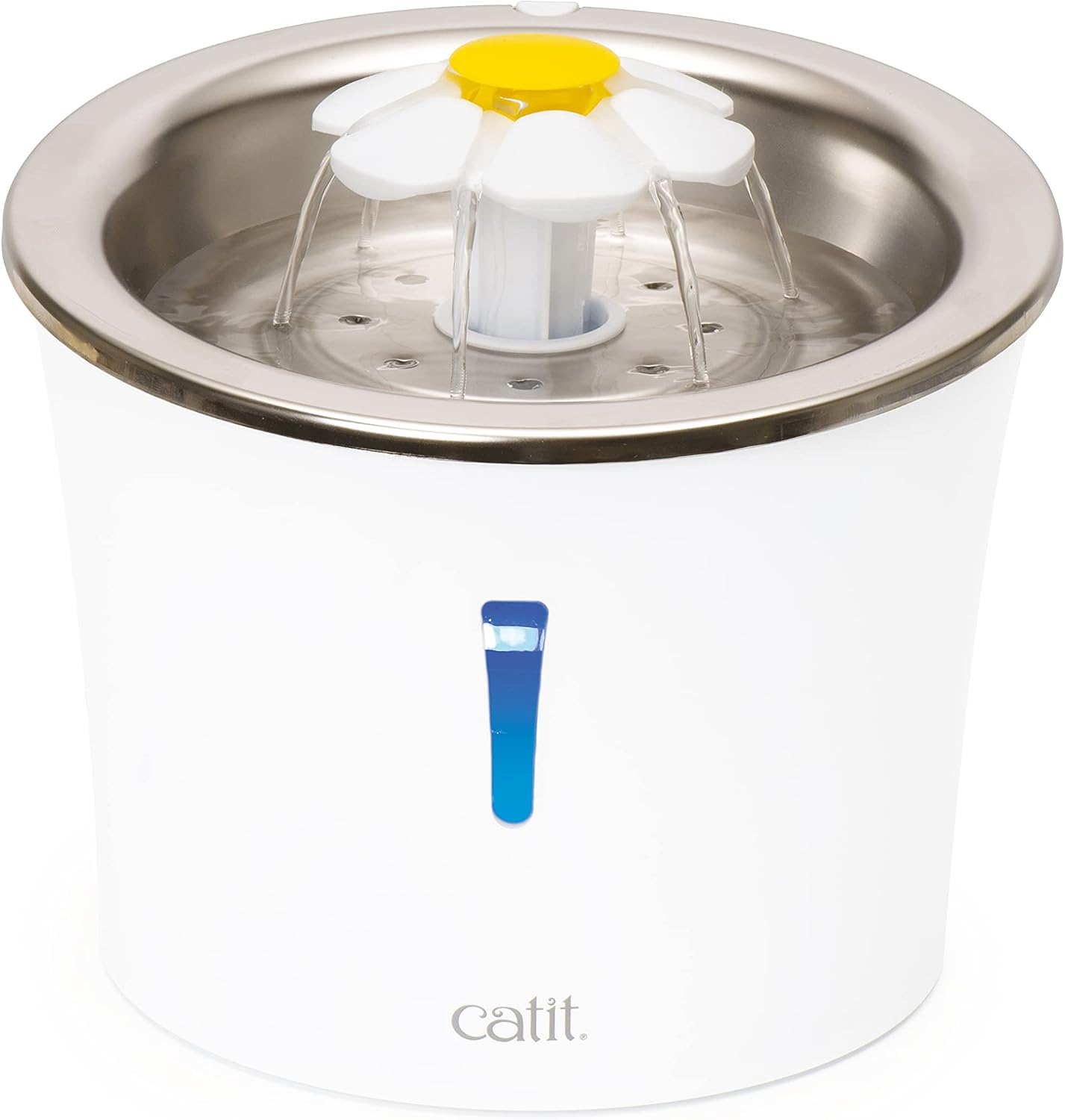
The Flower Fountain has been the default recommendation in this category for years, and the stainless-topped version fixes the main complaint about the original: the plastic flower top scratched, and scratched plastic in a water bowl is where biofilm lives. It has the largest evidence base of any fountain on the market by a wide margin, close to fifty thousand reviews behind a 4.3 star average, which means its failure modes are documented rather than guessed at. Three flow settings let you find the one your cat tolerates, a real advantage with a nervous animal. The trade-off is honest: the reservoir is still plastic, the pump is a conventional submersible one, and the filters are proprietary and needed every three to four weeks, so the running cost is higher than the sticker suggests. For most single-cat homes, and any home not yet sure a fountain will be used, this is where to start.
Pros
- The most thoroughly evidenced fountain on the market
- Stainless top removes the scratched-plastic biofilm problem of the original
- Three flow settings, useful for cats that are wary of splashing
- Enormous review base, so the failure modes are extremely well documented
Cons
- Reservoir is plastic even though the top plate is steel
- Proprietary filters every three to four weeks add up over a year
Best engineered for one or two cats
PETKIT Eversweet 3 Pro
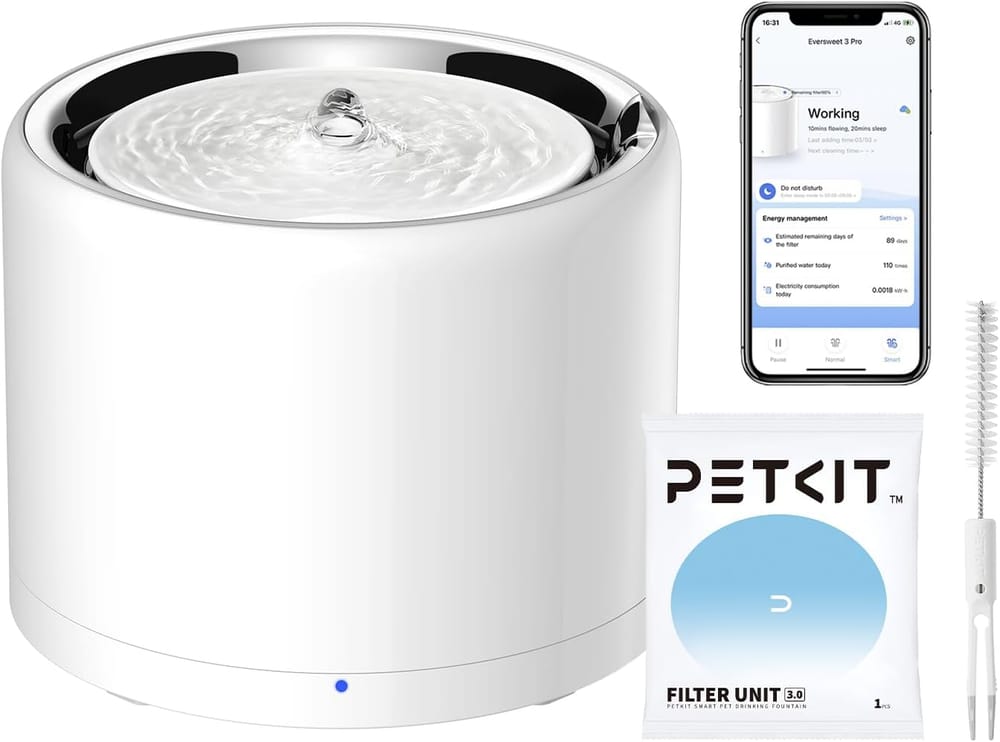
The best-engineered fountain here for one or two cats, and the pick if the pump argument below persuades you. The pump is wireless and inductive, so there is no cable in the water and no brushed motor to wear, and the container is genuine 304 stainless steel rather than a steel plate over a plastic tub. PETKIT rates the 1.6L capacity at five to seven days for one or two cats. Be clear about what it is not: the pump is wireless but the fountain is not cordless, because it sits on a mains-powered base. The review base is under a thousand at 4.1 stars, so the long-run evidence is thinner than for the Catit, and the Bluetooth app is something you can ignore rather than a reason to buy.
Pros
- Wireless inductive pump with no cable in the water
- Genuine 304 stainless steel container, not steel over plastic
- Five to seven days of water for one or two cats, per PETKIT
Cons
- Mains-powered base, so not cordless despite the wireless pump
- Under a thousand reviews, so long-run evidence is thin
Best for multi-pet households
PETKIT EVERSWEET MAX Cordless Fountain
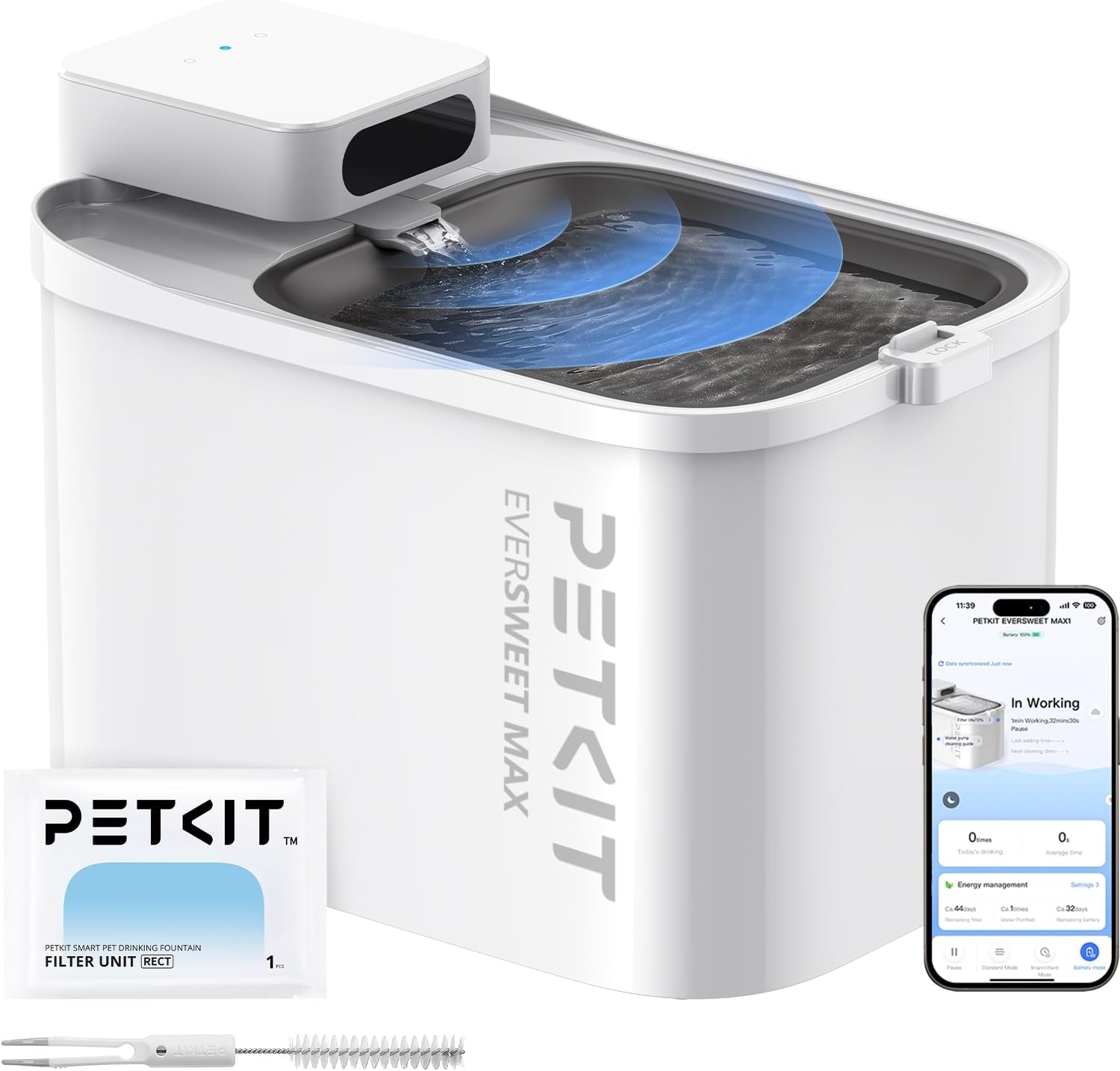
The EVERSWEET MAX is the one to get if you have three cats, or a dog that empties a bowl in one go. The 3L reservoir is the largest here, and PETKIT quotes battery life in weeks rather than days because a motion sensor lets the pump idle when no animal is nearby instead of running twenty four hours a day. That is the smartest engineering decision in this roundup: the less the pump runs, the longer it lives. Like the Eversweet 3 Pro it uses a wireless pump with no cable in the water, but it runs on a battery rather than a mains base. Two honest reservations. First, the review base is small at a few hundred, so the long-run picture is thinner than we would like on a product this expensive. Second, the app is a genuine benefit if you want drinking data on a cat with kidney concerns and pure friction if you do not, and there is no way to opt out of the account.
Pros
- 3L capacity, comfortably the most here, suits three cats or a dog
- Motion sensor idles the pump, which extends both battery and pump life
- Wireless pump, no cord in the water
- Drinking data per animal is genuinely useful with a senior or CKD cat
Cons
- Only a few hundred reviews, so long-term reliability is not yet proven
- Requires an account and app for setup whether you want one or not
Best ceramic, best for senior cats
PetSafe Drinkwell Pagoda Ceramic Fountain
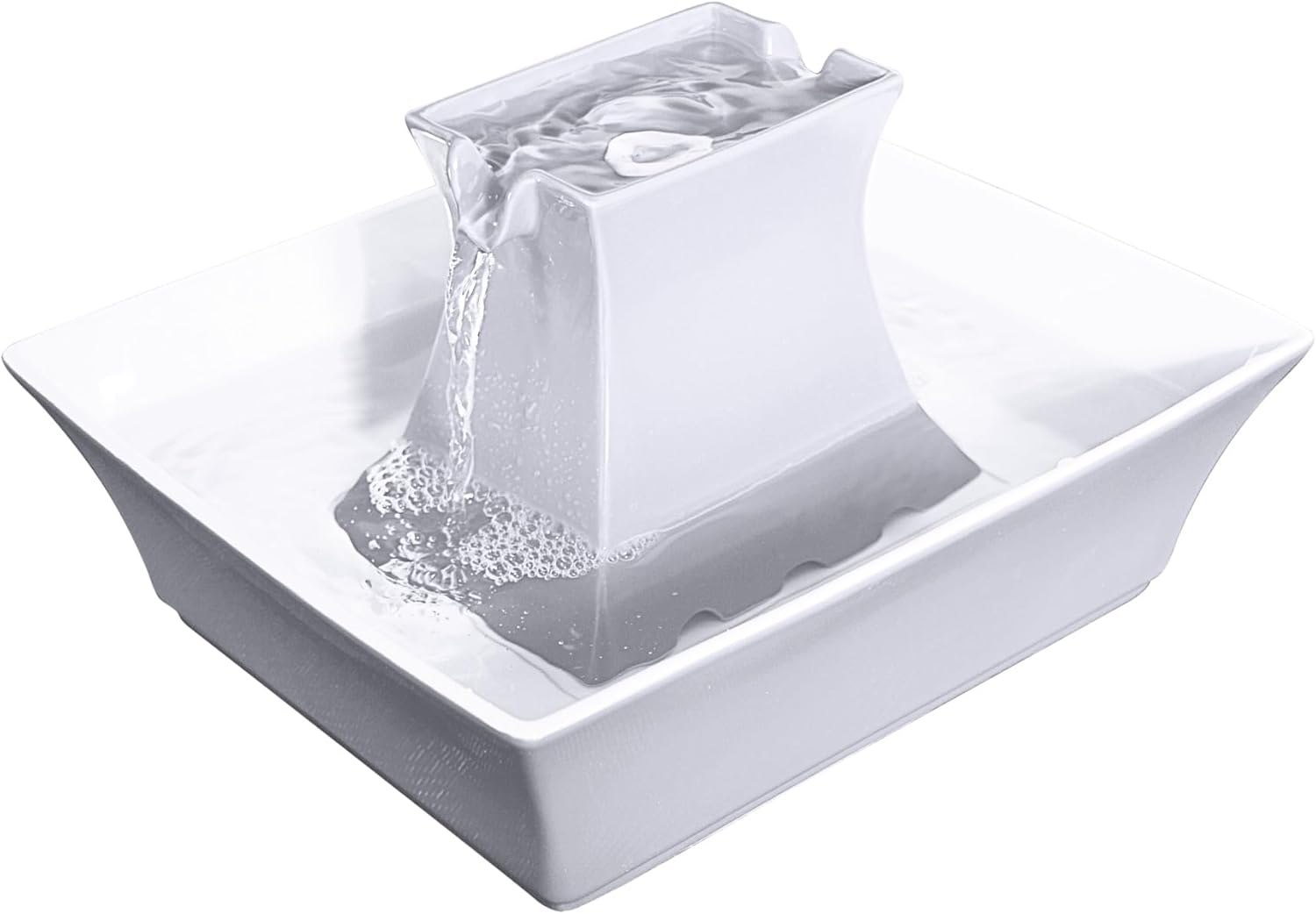
The Pagoda earns its slot on one design decision: it gives water at two heights, so an arthritic or senior cat does not have to crouch all the way to floor level to drink. If you have an older animal that has started drinking less, that is the single most useful feature in this roundup. It is properly ceramic rather than steel-over-plastic, so it is heavy enough to stay where you put it, scratch resistant, and the bowl and tower go in the top rack of the dishwasher. The open bowl design also means there is still water to drink if the power goes out and the pump stops. Against it: the submersible pump is conventional and the tower has an internal channel that needs the supplied brush every couple of weeks or it gets slimy where you cannot see it. Ceramic also chips if you knock it against a tap.
Pros
- Two drinking heights, a real benefit for senior and arthritic cats
- Genuine ceramic, heavy, scratch resistant, top-rack dishwasher safe
- Open bowl means water is still accessible in a power cut
- Filters are widely stocked and cheap, unlike some proprietary ones
Cons
- The internal tower channel needs brushing regularly or it harbours slime
- Ceramic chips if handled roughly at the sink
Best budget
PETLIBRO Capsule Cat Water Fountain
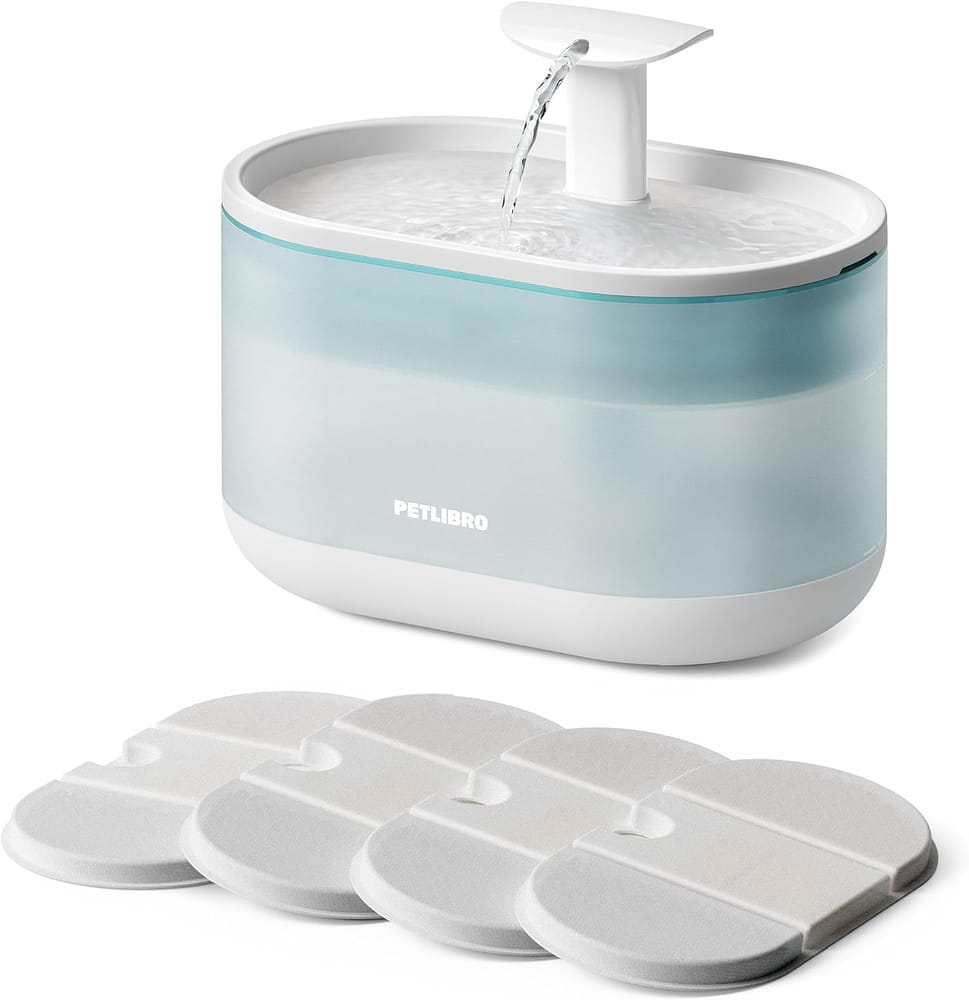
The fountain for someone who wants moving water without spending much, and a much stronger budget option than most, at a 4.3 star average across nearly nineteen thousand reviews. The filter is the reason: a large carbon capsule plus a sponge covers almost the whole tray rather than sitting in one corner, and PETLIBRO's outlet design stays quiet as the water runs low, which is exactly when cheaper fountains start to gurgle. Two flow modes, a window to watch the water level, and a small reserve that keeps a little water available if the pump stops. It is BPA-free plastic throughout, so it scratches in time and wants more frequent cleaning than steel or ceramic.
Pros
- Large filter capsule covers almost the whole tray
- Stays quiet as the water level drops
- Visible water level window
- Strong rating across a very large review base
Cons
- All plastic, so it scratches and holds biofilm in time
- 2.1L suits small and medium pets rather than a busy house
Frequently asked questions
Do cat water fountains actually make cats drink more?
For a lot of cats, yes. Cats evolved drinking from moving water and many are wary of a still bowl that has sat out collecting dust and hair. Moving, aerated water is more appealing to them and it tastes fresher because the carbon filter is constantly stripping out the flat, chlorinated taste of tap water. The honest caveat is that this varies by cat. Some take to a fountain in an hour, some ignore it for a fortnight, and a few never use one. Leave the old bowl out alongside it for the first two weeks rather than forcing the switch.
How often do you have to clean a cat water fountain?
Rinse the bowl and top up every two to three days, do a full strip and scrub every one to two weeks, and change the carbon filter every two to four weeks depending on the model and how many animals use it. The step people skip is the pump: slime builds up inside the impeller housing where you cannot see it, and that is what turns a quiet fountain into a rattling one. Most pumps pop apart into three pieces and need an old toothbrush once a fortnight.
Stainless steel, ceramic or plastic?
Stainless steel and ceramic are both easier to keep genuinely clean than plastic, because plastic develops fine scratches that hold biofilm, and biofilm on a water bowl is a known contributor to feline chin acne. Ceramic is the most pleasant to live with and the heaviest, so it does not get shoved around the floor. Stainless steel is the most practical because it is dishwasher safe and unbreakable. Watch the marketing, though: plenty of fountains sold as stainless steel have a steel top plate over an entirely plastic reservoir.
Why do cat fountain pumps fail so often?
Because most of them are cheap brushed DC motors running continuously, which is the hardest duty cycle you can give that design. Grease migrates out of the bearing, the impeller shaft starts to grind, and you get the whine that owners report at around the six month mark. Running the fountain dry accelerates it dramatically, which is why capacity and a low-water cutoff matter more than they look like they should. Wireless inductive pumps, used by PETKIT and PETLIBRO on their cordless models, have no contact friction and last considerably longer.
How much do the filters cost per year?
Budget roughly 25 to 60 dollars a year per fountain, and check it before you buy rather than after. A fountain that needs a proprietary filter every two weeks can quietly cost more over three years than a more expensive model that takes a cheap generic one every month. We factor this into the value score for every pick on this page, because it is the cost nobody mentions in the review that made you buy.