Dog Nail Grinder vs Clippers (2026): Which Should You Actually Use?
Grinder or clippers for dog nails: how each fails, which is safer on black nails, which suits an anxious dog, and why many households own both.
The honest answer is that this is not a quality question. Both tools work. They fail differently, and the right one depends on your dog’s nails and your dog’s temperament rather than on which is better.
Clippers: fast, silent, committed
A clipper takes the whole cut in one motion. That is its advantage and its risk. There is no feedback loop: you place the blade, you squeeze, and you find out afterwards whether you judged it right.
On pale nails that is fine, because the quick is visible as a pink line and you simply stop short of it. On black nails you are guessing, and a guess that lands wrong bleeds, hurts, and can cost you months of cooperation.
Blade quality is nearly the whole product. Sharp blades part a nail; blunt ones crush it, and a crushed nail splits lengthways. Test a new pair on your own fingernail before going near the dog.
Grinders: slow, controlled, noisy
A grinder removes a sliver at a time, which means you can inspect the cut face after every pass and stop the moment the quick’s dark dot appears. For black nails, or for a dog whose nails have been left long, that control is worth the extra time.
What you pay is noise and vibration. That is the whole reason grinders get refused: not pain, but a whining tool buzzing through the paw you are holding. It is also why introducing one properly over a week, tool off then on across the room then near the paw, matters more than which model you buy.
The other cost is mess. Grinding produces a surprising volume of fine keratin dust, and that dust is what eventually clogs a grinder and kills it.
How to choose in one line each
Pale nails, cooperative dog, limited patience: clippers. Black nails, or a dog that has already had a bad experience with a cut: grinder. Overgrown nails that need shortening gradually over weeks: grinder, because you can take a whisker off at a time as the quick recedes.
A dog frightened specifically of noise: clippers, or the quietest grinder you can find. Our best dog nail grinders roundup ranks the LuckyTail first on that measure at roughly 30 to 45 decibels, and our best dog nail clippers guide covers the guarded models that make a beginner’s first cut hard to get badly wrong.
Whichever you choose, the technique for finding the quick is the same, and it is the part worth learning properly before the tool arrives. Our guide to trimming dog nails without hitting the quick covers it, including what to do in the first thirty seconds if you catch it.
Cats need neither of these. Feline claws are thin, curved and retractable, and want the small angled blades in our best cat nail clippers roundup.
How we test
Every pick is scored on the same five criteria and cross-checked against real owner feedback - so the ranking reflects how a product holds up after six months in a real house with a real animal, not its spec sheet.
Build
Materials and construction: pump and motor quality, whether plastics are food safe, and how well the thing is actually put together.
Cleaning
How much work it is to keep hygienic. Dishwasher-safe parts, how many pieces it breaks into, and whether biofilm can hide in a corner you cannot reach.
Durability
Whether it survives months of daily use, chewing, scratching and repeated washing without the motor dying or the seals failing.
Pet fit
Whether animals will actually use it: size range, whisker clearance, height, and how the design suits nervous or senior pets.
Value
What you get for the price, including the running cost of filters, liners and other consumables it locks you into.
Best grinder
Dremel PawControl 7760-PGK Dog Nail Grinder Kit
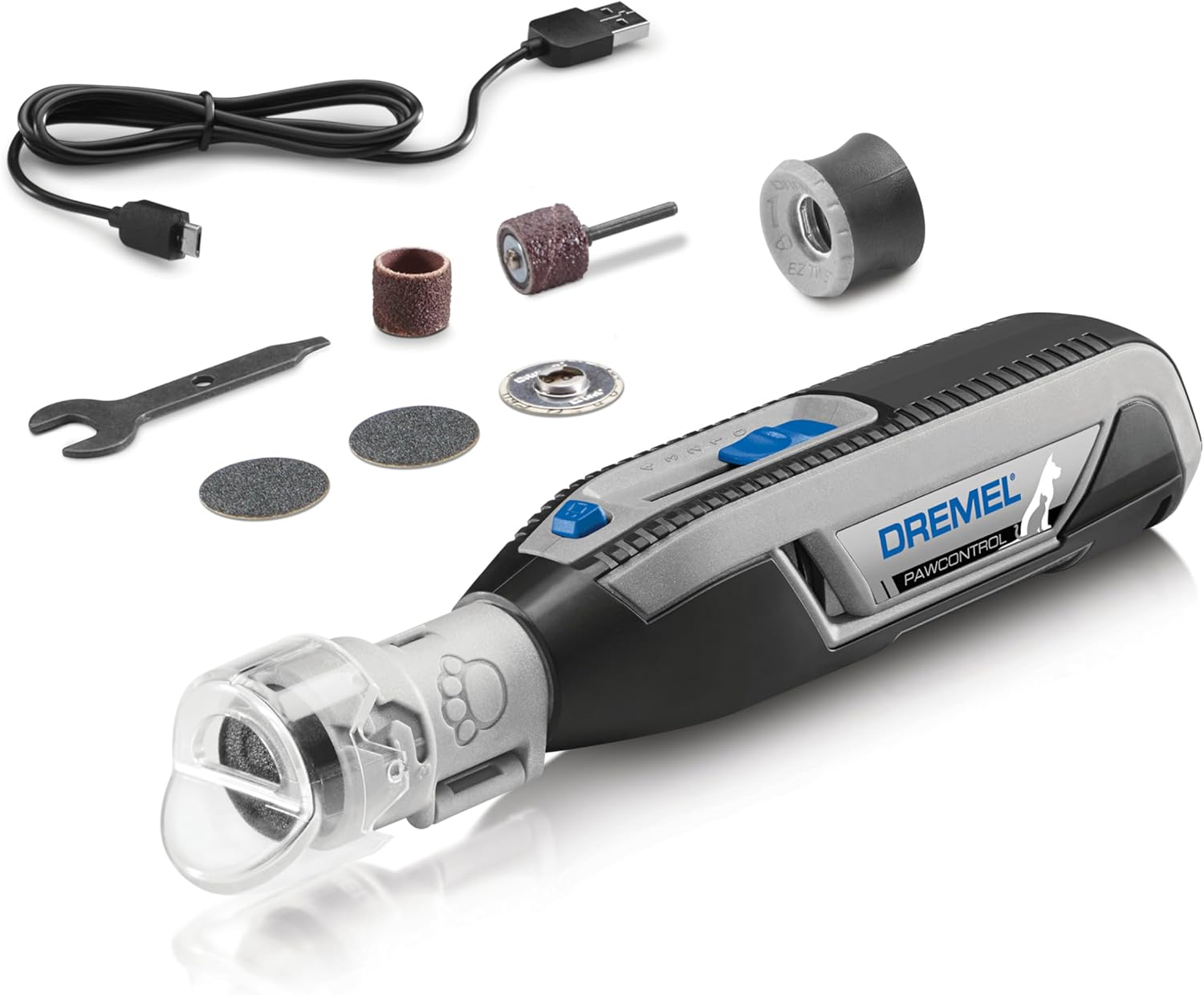
The only tool in either category made by a company whose main business is rotary tools, and it shows where it counts. The motor holds its speed when the bit meets a thick nail rather than bogging down, which turns four nervous passes into one confident one. Variable speed lets you start slow with a wary dog and speed up for a Labrador's back nails, and the 45 degree paw guide is the single most useful accessory here because it stops you rolling off the nail into the quick. At 4.5 stars across nearly seventeen thousand reviews it is the best-rated grinder we found. It is louder and bulkier than the pen-shaped tools, and priced like the power tool it is.
Pros
- Holds speed under load, so thick nails take one pass
- Variable speed rather than two fixed settings
- The 45 degree guide genuinely reduces quicking risk
- Best rated grinder across a very large review base
Cons
- Louder and bulkier than pen-style grinders
- The most expensive tool in either category
Best clippers
Millers Forge Stainless Steel Dog Nail Clipper 743C
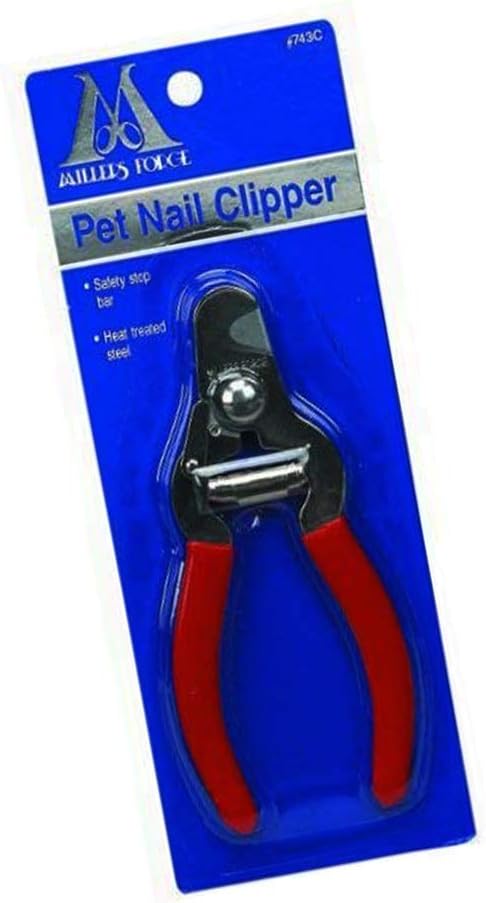
The pair on most grooming tables, and it earns that by being a proper tool rather than a pet accessory. German stainless blades, made in Italy, spring loaded so the handles reopen themselves, and sharp enough that a thick nail parts cleanly instead of being crushed. That distinction matters more than it sounds: a crushed nail splits along its length and can tear days later. At 4.6 stars it is the best-rated clipper we tested. There is no safety guard, deliberately, so this is the pick for someone confident about where the quick is rather than a nervous beginner.
Pros
- German stainless blades that stay sharp for years
- Spring loaded, so the handles reopen on their own
- Cuts cleanly rather than crushing and splitting the nail
- Cheap for the quality of steel
Cons
- No safety guard, so it assumes you know where the quick is
- Hard plastic grips are functional rather than comfortable
Frequently asked questions
Which is safer for black nails?
The grinder, by a clear margin. On a black nail you cannot see the quick, so you work from the cut surface instead: grind a little, look, and stop when a small dark dot appears in the middle of a chalky white face. A grinder removes a fraction of a millimetre at a time, so you get several chances to spot that dot. Clippers commit to the whole cut at once, with no feedback until it is done.
Which is faster?
Clippers, and it is not close. Four paws takes about two minutes with clippers against ten or more with a grinder, because grinding is deliberately slow. If your dog tolerates having its feet handled and has pale nails where the quick is visible, that speed is a real advantage and there is no reason to buy a grinder.
Which is better for a dog that hates nail trims?
It depends what the dog objects to. If it hates the sudden crunch and the committed feel of a cut, the grinder is the easier sell once desensitised, because nothing abrupt happens. If it is frightened of noise and vibration, clippers are silent and the grinder is the thing it will flee. Work out which of the two your dog is reacting to before spending money.
Can you use both?
That is what many households settle on, and it is the sensible answer. Clippers take the bulk of the length off quickly, then twenty seconds with a grinder rounds the edge so nothing catches on carpet or bare legs. You get the speed of one and the finish of the other.