The Best No Pull Dog Harnesses (2026)
No pull dog harnesses from rabbitgoo and PetSafe, compared on front-clip versus back-clip, why fit beats brand, and what a harness cannot fix.
A no-pull harness changes the physics of a walk on the first outing. What it does not do is teach a dog to walk nicely, and the gap between those two things is where most disappointment lives.
Why a front clip works
A back clip sits behind the dog’s centre of mass, so pulling into it is exactly the sledding position: the dog gets traction and you get dragged. A front clip sits on the chest, so the same effort turns the dog toward you. The pull stops producing forward motion, which is the point.
The Easy Walk goes further with a martingale loop that tightens slightly as the dog leans in, which redirects a determined puller more firmly than a plain ring. PetSafe still pitch it at light to moderate pulling, and our PetSafe Easy Walk review covers which of its three versions to buy.
Fit beats brand, every time
Almost every complaint about no-pull harnesses is a fitting problem: rubbing in the armpits, the dog backing out of it, a chest strap riding up onto the throat. Our guide to measuring a dog for a harness covers where the tape goes. Measure girth at the deepest part of the chest, buy to that number rather than to breed, and check two flat fingers slide under any strap.
Check the fit again after a week. Harnesses settle, coats change with the seasons, and a strap that was right in October can be tight in February on a dog carrying winter weight.
What a harness cannot do
It cannot make a car journey safe. A seat belt loop keeps a dog on the seat and out of the footwell, which is worth having, but none of these are sold as crash tested and you should not treat them as such. Our best dog car seat covers roundup makes the same point from the other direction: covers protect upholstery, not dogs.
It also cannot fix a dog that pulls because it is over-aroused before the walk even starts. If yours vibrates through the whole pre-walk routine, the harness is one small part of the answer, and the same calm-handling approach that makes nail trims uneventful in our best dog nail grinders guide applies here too.
The honorable mentions list is empty on purpose. What remained after these five resolved to variant listings of harnesses already ranked above, and the same product in another colour is not an alternative.
One use these harnesses are not sold for is the car. A back ring is the right anchor for a travel tether, but the tether is a separate purchase and none of these are crash tested; our best dog seat belts and car restraints roundup covers what a restraint does and does not do.
How we test
Every pick is scored on the same five criteria and cross-checked against real owner feedback - so the ranking reflects how a product holds up after six months in a real house with a real animal, not its spec sheet.
Build
Materials and construction: pump and motor quality, whether plastics are food safe, and how well the thing is actually put together.
Cleaning
How much work it is to keep hygienic. Dishwasher-safe parts, how many pieces it breaks into, and whether biofilm can hide in a corner you cannot reach.
Durability
Whether it survives months of daily use, chewing, scratching and repeated washing without the motor dying or the seals failing.
Pet fit
Whether animals will actually use it: size range, whisker clearance, height, and how the design suits nervous or senior pets.
Value
What you get for the price, including the running cost of filters, liners and other consumables it locks you into.
Best overall
rabbitgoo No-Pull Dog Harness
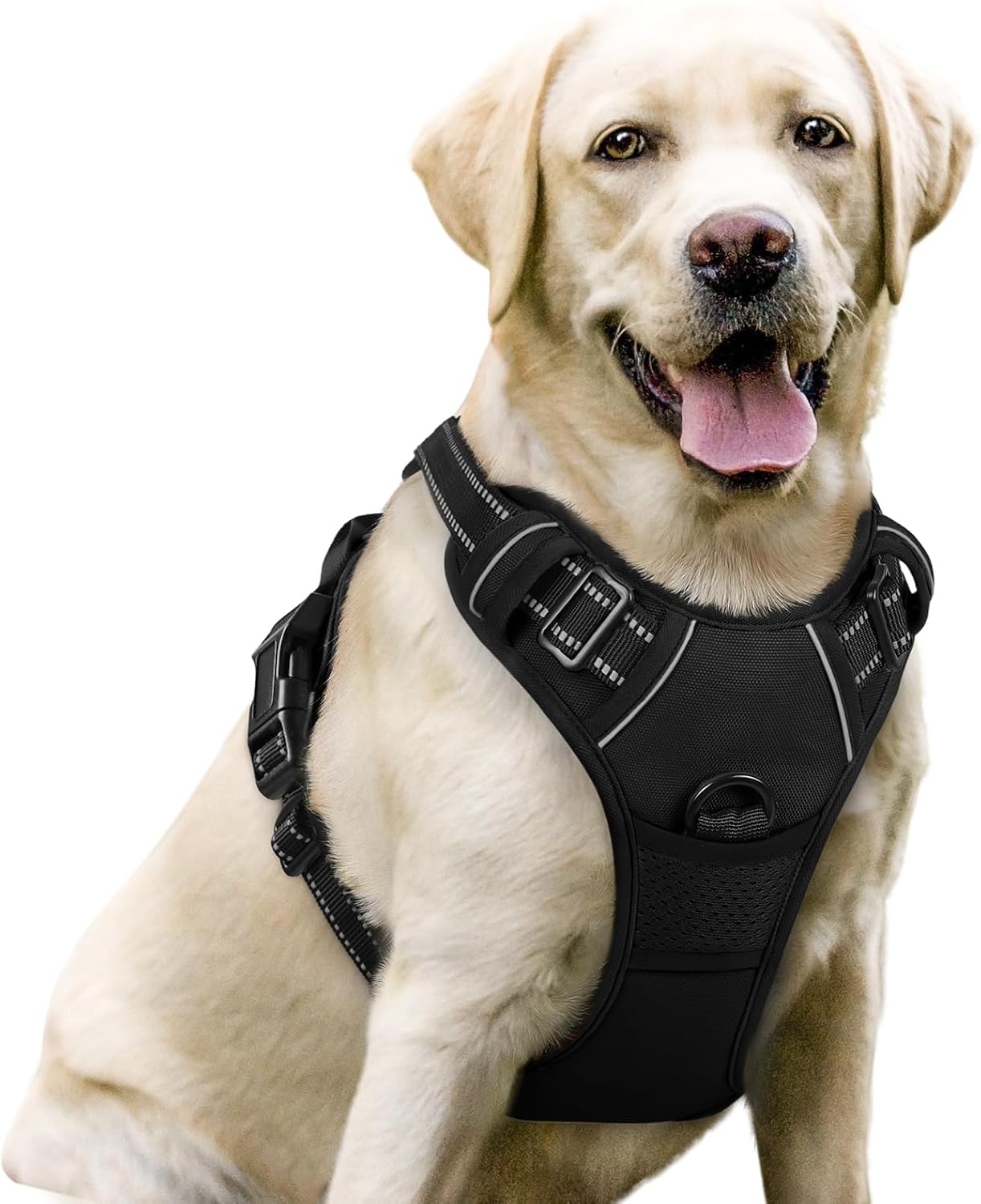
With close to two hundred thousand reviews at 4.5 stars, this is the most thoroughly evidenced dog product we have looked at anywhere on this site, and it holds up. You get both a front and a back ring so you can run a double-ended lead, four adjustment points that let you fit an awkwardly shaped dog properly, and a top handle that is genuinely useful for hauling a dog back from a road edge or lifting one into a boot. The padding is soft enough for a short-coated dog without the bulk that makes some harnesses hot in summer. It is not indestructible: the buckles are the weak point on a very strong dog, and the reflective stitching wears before the webbing does. At this price that is easy to accept.
Pros
- Front and back rings, so a double-ended lead works properly
- Four adjustment points fit deep-chested and barrel-chested dogs alike
- Genuinely useful top handle for close control
- The largest review base of any product on this site
Cons
- Buckles are the first thing to fail on a very strong dog
- Reflective stitching wears noticeably before the webbing does
Best for immediate control
PetSafe Easy Walk Comfort No-Pull Harness
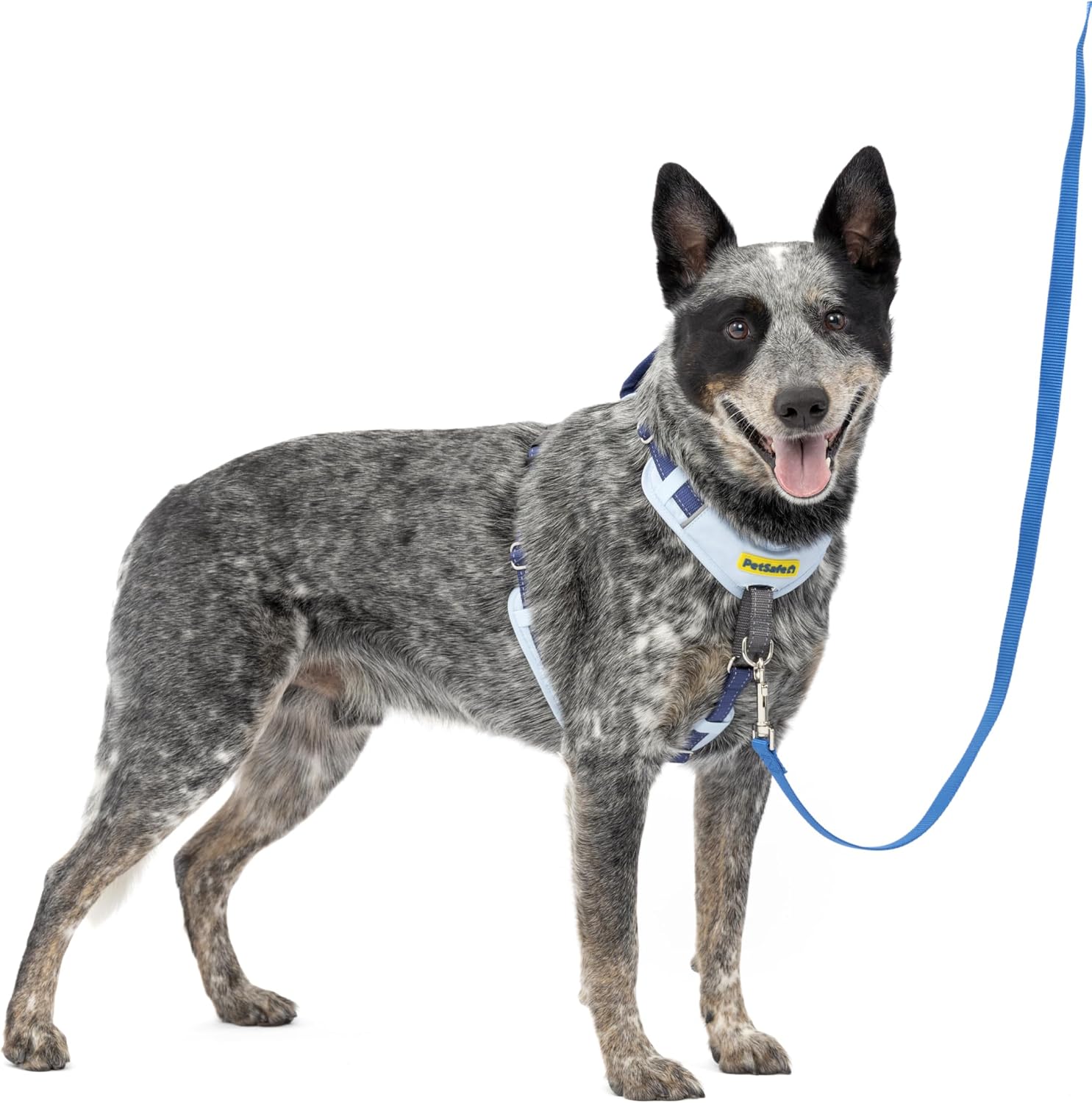
The Easy Walk is the harness most often recommended for a dog that pulls, and the reason is the front martingale loop. Rather than a fixed front ring, the loop tightens slightly and steers the dog sideways, which takes more of the power out of a determined puller than a plain front clip does. This Comfort version adds full body padding to the original design, addressing the long-standing complaint about strap rub in the armpits. Fit is fussier than the rabbitgoo and the five adjustment points take a couple of goes to get right, but once set it redirects harder than anything else here, though PetSafe pitch the design at light to moderate pulling rather than a genuinely powerful dog. At 4.2 stars on a few hundred reviews for this newer version, the evidence base is thinner than the original's.
Pros
- Front martingale loop redirects harder than a plain front ring
- Full body padding fixes the armpit rub of the original design
- Five adjustment points for a properly custom fit
- The design most commonly recommended by trainers
Cons
- Fussier to fit correctly than anything else here
- Newer version, so a thinner review base than the classic
Best for car journeys
PetSafe 3 in 1 No-Pull Harness
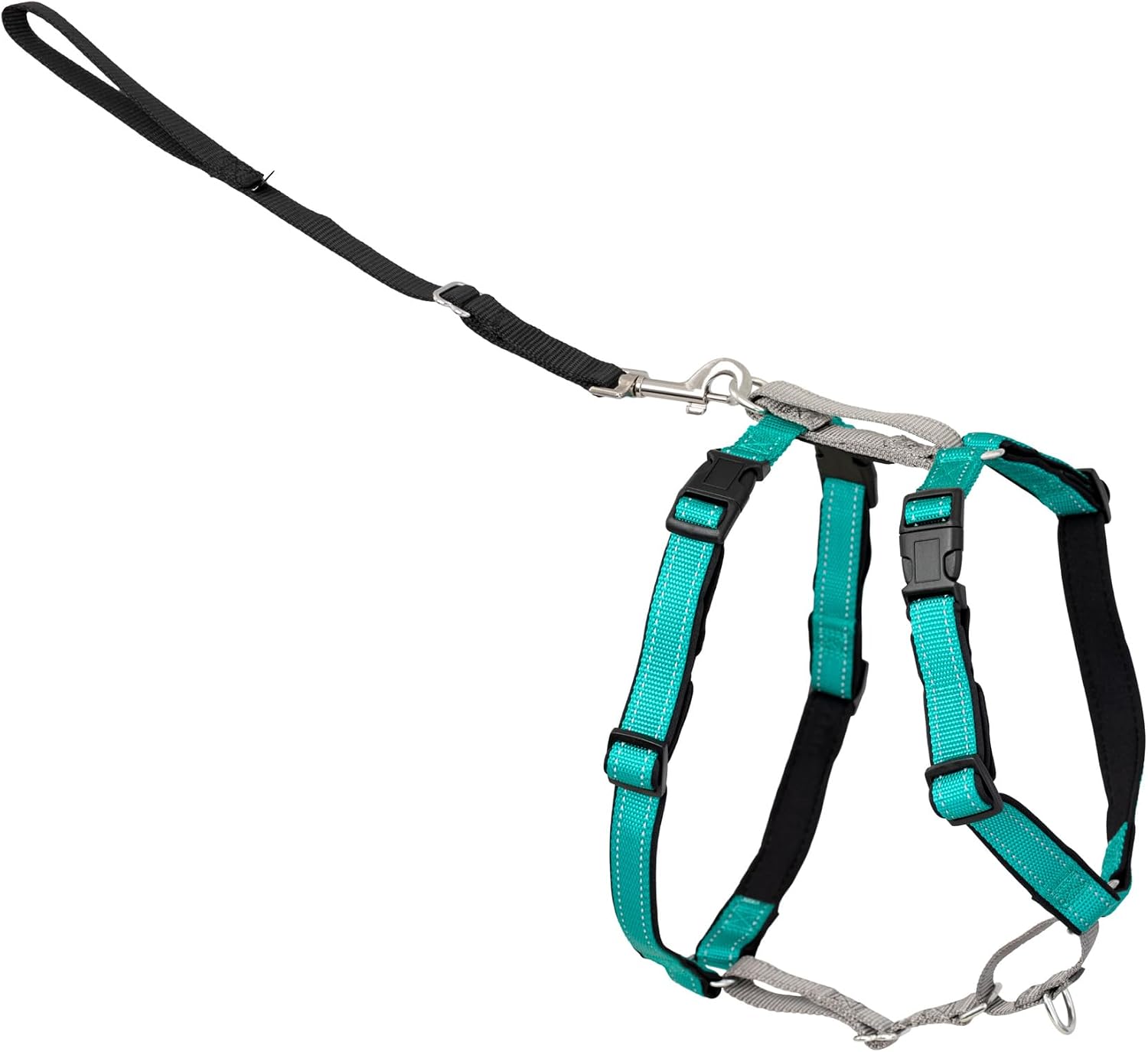
This is the one to buy if the dog's day involves a car as well as a walk. Alongside the front and back leash points there is a seat belt loop, so the same harness the dog walks in becomes its car restraint without a second purchase or a change of kit at the kerb. That convenience is the whole argument for it, and it is a good one for dogs that travel daily. Read the safety claim carefully though: a seat belt loop keeps a dog on the seat and stops it roaming the cabin, which is not the same as a crash-tested restraint, and PetSafe does not claim crash testing here. As a walking harness it sits between the other two, with a fixed front ring rather than a martingale loop.
Pros
- Seat belt loop means one harness for walking and travelling
- Front and back leash points plus a control handle
- Reflective accents, useful on winter walks
- Well evidenced at 4.4 stars across nine thousand reviews
Cons
- Seat belt loop is not a crash-tested restraint, and is not sold as one
- Fixed front ring redirects less firmly than the Easy Walk's loop
Best built
Ruffwear Front Range Dog Harness
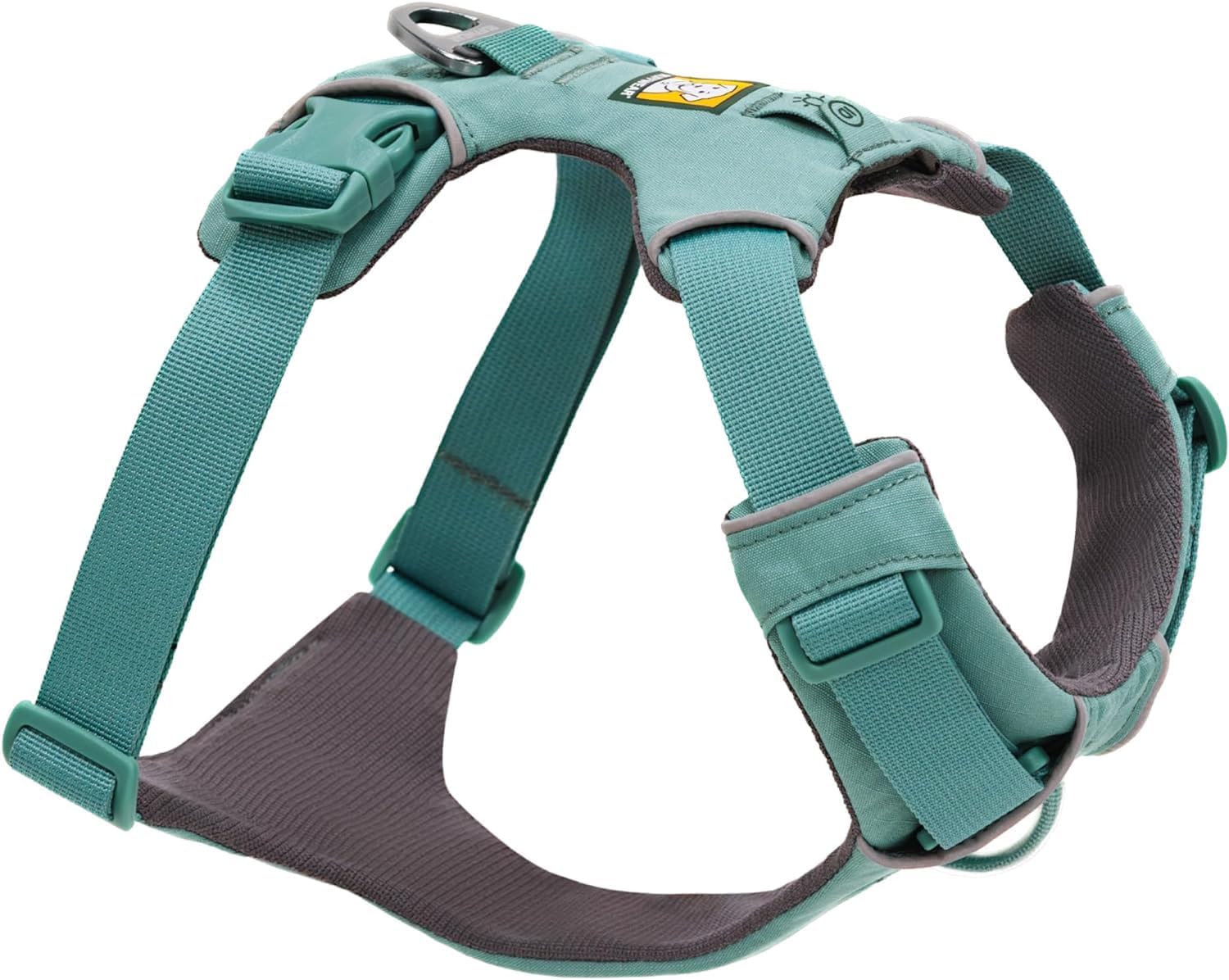
The Ruffwear is the one that survives daily use for years, and it is the pick if your dog is outdoors in weather rather than walking pavements. The webbing and stitching are a visible tier above everything else here, the aluminium V-ring on the back does not deform under a lunging dog the way stamped hardware does, and the padding is spread across the chest rather than concentrated where the straps pull. Four adjustment points and a reflective trim throughout. At 4.6 stars across nearly nineteen thousand reviews it is the best rated harness on this page. It is also the most expensive by some margin, and its front ring is a plain reinforced loop rather than a martingale, so it redirects less firmly than the Easy Walk's loop.
Pros
- Best materials and hardware here; an aluminium V-ring, not stamped steel
- Padding spread across the chest rather than concentrated at the straps
- Reflective trim all round, not just a token strip
- Best rated harness on this page
Cons
- The most expensive option by a clear margin
- Plain front loop redirects less firmly than a martingale design
Best for strong pullers
2 Hounds Design Freedom No-Pull Harness
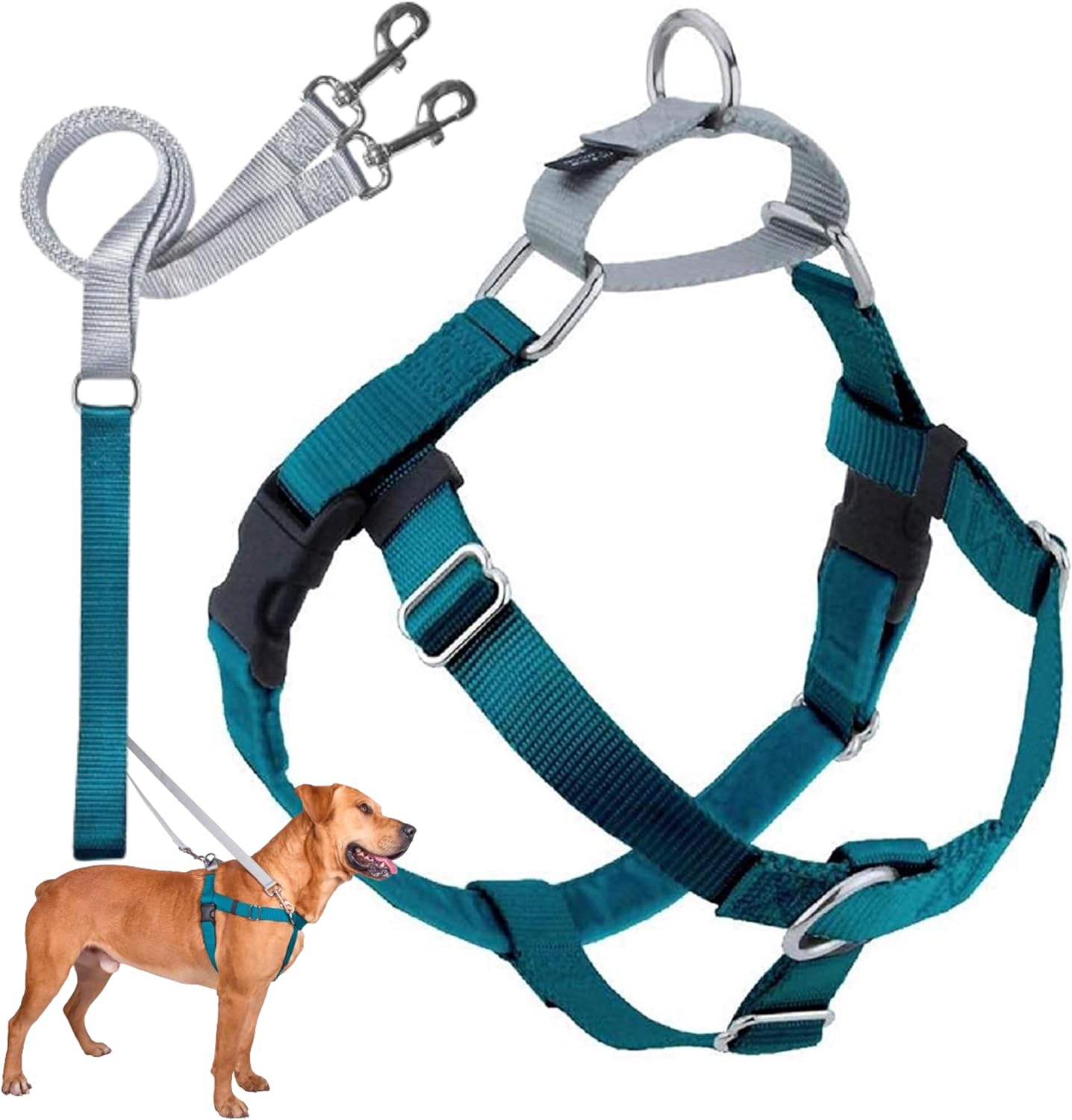
The Freedom is what trainers reach for when a dog is strong enough that the walk has become unsafe. A martingale loop on the chest tightens slightly as the dog leans in, and a velvet-lined strap behind the front legs stops the rubbing that martingale designs are otherwise prone to. It ships with a double-ended lead, which matters: clipping front and back at once gives you steering rather than just resistance, and that is the setup most professionals actually use. Made in the USA with stainless hardware. It is fiddly to fit correctly the first time, it costs more than the rabbitgoo by a wide margin, and at 4.3 stars it rates below the Ruffwear, with most complaints about sizing rather than durability.
Pros
- Martingale chest loop redirects harder than any plain front ring here
- Velvet-lined strap behind the legs, which is where rubbing starts
- Includes the double-ended lead that makes a front clip work properly
- Stainless hardware, made in the USA
Cons
- Fussiest harness here to fit correctly the first time
- Rated below the Ruffwear, mostly on sizing complaints
Frequently asked questions
Does a no-pull harness actually stop pulling?
It reduces it immediately and it does not train it away. A front clip turns the dog toward you when it pulls, so forward pressure becomes a change of direction instead of forward motion. That takes most of the power out of a pulling dog on the first walk. But the dog has not learned anything yet, and if you go back to a back clip the pulling returns. Treat the harness as the thing that makes training possible rather than the training itself.
Front clip or back clip?
Front for control, back for comfort on a dog that already walks well. Many harnesses here have both, and the sensible pattern is front clip on pavement where control matters and back clip on a trail or for running, where a front lead tangles under the legs. A double-ended lead using both rings at once gives the most control of all and is what most trainers use.
How do I measure my dog?
Girth is the measurement that matters: around the deepest part of the chest just behind the front legs, with the tape snug but not tight. Neck is secondary. Buy on girth, not on breed, because two Labradors can be two sizes apart. If you fall between sizes, size up only if the harness has enough adjustment to take it back in.
Will a harness rub or hurt my dog?
It can if it sits wrong. The chest strap should cross the breastbone, not the throat, and you should fit two flat fingers under any strap. Watch the armpits on a short-coated dog for the first week, because that is where rubbing shows first. If your dog develops a sore or starts avoiding the harness, stop using it and re-fit rather than pushing through.