How To Measure a Dog For a Harness (And Why Sizing Charts Lie)
Where to put the tape, why girth beats breed or weight, the two-finger fit test, and how to tell whether rubbing is bad sizing or the wrong harness.
Almost every complaint about a no-pull harness is a fitting complaint wearing a costume. Rubbing, backing out, a chest strap riding up onto the throat: none of those are manufacturing faults, and none are fixed by buying a different brand in the same wrong size.
Measure girth, not breed
Girth is the circumference of the chest at its deepest point, immediately behind the front legs. Stand the dog up, run a soft tape all the way round, and keep it snug against the coat without pulling it into the fur.
That number is what you buy on. Breed is not a size: two Labradors from different lines can be two harness sizes apart, and weight is worse still because it says nothing about chest shape. A 25kg barrel-chested bulldog and a 25kg deep-chested greyhound need entirely different harnesses.
Neck measurement matters on some designs and not at all on step-in ones. Where a chart asks for both and they point to different sizes, size on girth.
The two-finger test
Once it is on, you should be able to slide two flat fingers under any strap, anywhere, without forcing them. Tighter than that and you will get rubbing; looser and the dog can twist out of it.
Then check three positions specifically. The chest strap should cross the breastbone, not the throat. The strap behind the front legs should sit a couple of centimetres back from the armpit rather than in it. And the back ring should sit between the shoulder blades rather than sliding off to one side, which is a sign the whole thing is rotating because it is too loose.
Re-check after a week, and after a season
Harnesses settle and dogs change. Webbing stretches slightly with use, and a strap that was right in October can be tight in February on a dog carrying a winter coat and a little winter weight.
On a short-coated dog, look under the armpits during the first week specifically. That is where rubbing shows first, and catching it early is the difference between an adjustment and a sore that stops you walking the dog for a fortnight.
Fit is not a training method
A well-fitted harness changes the physics of a walk immediately, because a front clip turns a pulling dog toward you instead of letting it lean into the pressure. What it does not do is teach the dog anything. Go back to a back clip and the pulling returns.
Our best no pull dog harnesses roundup covers which designs redirect hardest and which suit a dog that already walks reasonably, including the martingale-loop design covered in depth in our PetSafe Easy Walk review.
Girth is also the measurement that decides coat sizing, so the tape you just used works for the wet-weather kit too: our best dog raincoats roundup covers fitting a coat over a harness without the two fighting each other.
One boundary worth naming: a harness is not a car restraint. A seat belt loop keeps a dog on the seat and out of the footwell, which is worth having, but none of the harnesses we rank are sold as crash tested. Our best dog car seat covers guide makes the same point from the other side, and the two together are interior protection rather than safety equipment.
If your dog has a sore, a bald patch, or flinches when the harness goes on, stop using it and check the fit before assuming the dog is being difficult. Persistent soreness is a vet question.
How we test
Every pick is scored on the same five criteria and cross-checked against real owner feedback - so the ranking reflects how a product holds up after six months in a real house with a real animal, not its spec sheet.
Build
Materials and construction: pump and motor quality, whether plastics are food safe, and how well the thing is actually put together.
Cleaning
How much work it is to keep hygienic. Dishwasher-safe parts, how many pieces it breaks into, and whether biofilm can hide in a corner you cannot reach.
Durability
Whether it survives months of daily use, chewing, scratching and repeated washing without the motor dying or the seals failing.
Pet fit
Whether animals will actually use it: size range, whisker clearance, height, and how the design suits nervous or senior pets.
Value
What you get for the price, including the running cost of filters, liners and other consumables it locks you into.
Most adjustable
rabbitgoo No-Pull Dog Harness
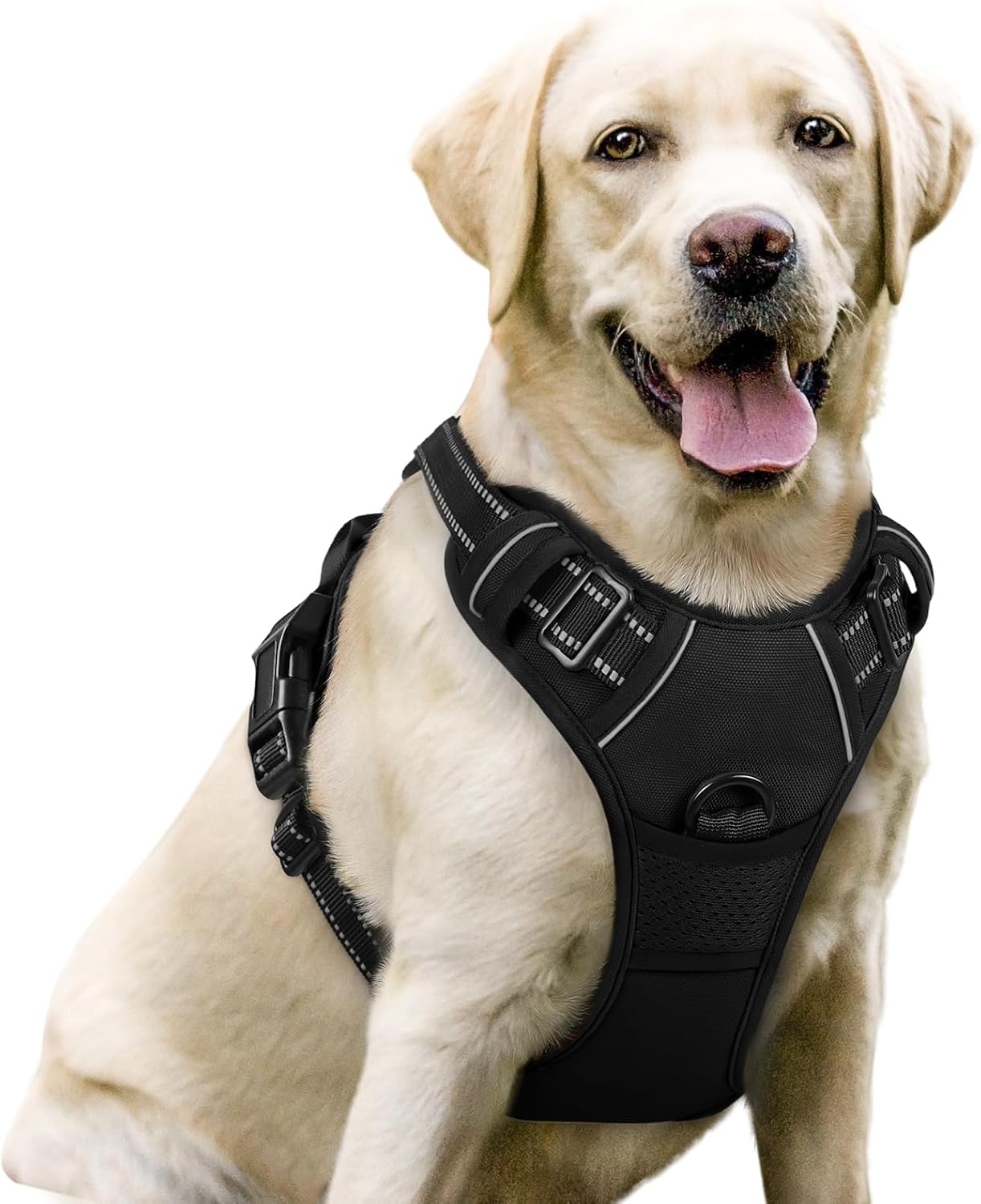
Four adjustment points is the reason this is the harness we suggest for an awkwardly shaped dog: a deep-chested lurcher and a barrel-chested staffie need very different geometry, and two-point harnesses cannot give it to them. It has both front and back rings so a double-ended lead works properly, and a top handle that earns its place hauling a dog back from a kerb. The padding is soft without the bulk that gets hot in summer. With close to two hundred thousand reviews it is the most thoroughly evidenced product we have looked at anywhere. The buckles are the weak point on a genuinely strong dog, and the reflective stitching wears before the webbing does.
Pros
- Four adjustment points fit deep and barrel-chested dogs alike
- Front and back rings for a double-ended lead
- Useful top handle for close control
- The largest review base of any product on this site
Cons
- Buckles fail before the webbing on very strong dogs
- Reflective stitching wears noticeably first
Frequently asked questions
Where exactly do I measure?
Girth is the measurement that matters: run a soft tape all the way around the deepest part of the chest, just behind the front legs, with the dog standing. Keep it snug against the coat without compressing it. Neck is secondary on most harnesses and irrelevant on step-in designs. If a chart asks for both, girth is the one to size on when the two disagree.
Should I size up if my dog is between sizes?
Only if the larger size adjusts down far enough to still fit. Check the stated adjustment range rather than assuming: a harness at the very bottom of its range sits with long tails of webbing flapping and the straps at odd angles, which is where rubbing starts. For a growing puppy, size up and expect to buy again anyway.
My dog backs out of its harness. What is wrong?
Almost always a chest strap sitting too far forward, up near the throat instead of across the breastbone, which lets the dog reverse out of the front. Refit it before replacing it. If it still happens, a harness with a second strap behind the ribcage, or a martingale-style front loop, physically prevents the manoeuvre.
It rubs under the armpits. Sizing or design?
Check fit first: you should slide two flat fingers under any strap, and the strap behind the front legs should sit a couple of centimetres back from the armpit rather than in it. If the fit is right and it still rubs, it is the design, and short-coated dogs are most affected. Padding across that strap is the specific feature to look for.