The Best Slow Feeder Dog Bowls (2026): What Actually Slows a Gulper Down
Slow feeder bowls from Outward Hound, UPSKY, Neater Pet Brands and Catit, with an honest look at what the bloat evidence does and does not say.
A dog that finishes a meal in ninety seconds and brings half of it back up on the rug five minutes later is the reason most people end up here. Slow feeders do fix that particular problem reliably. What they do about the bigger fear, bloat, is a more careful conversation, and it is worth having before you buy.
What the bloat evidence actually says
Gastric dilatation-volvulus is a true emergency and it kills dogs. The large case-control work on risk factors, most notably Glickman and colleagues in the Journal of the American Veterinary Medical Association in 2000, found that speed of eating was one of several factors associated with increased risk in large and giant breeds, along with chest depth to width ratio, being underweight, age, and a fearful or stressed temperament.
Reading that as “a slow feeder prevents bloat” is a jump the evidence does not support. It addresses one associated factor among several, most of which are structural to the dog and not something you can buy your way out of. If you have a deep-chested breed, the useful conversations are with your vet, about weight, feeding routine, and whether a preventative gastropexy makes sense for that individual.
What we can say plainly is that a slow feeder reliably stops the regurgitation problem, reliably makes meals more interesting for a bored dog, and costs very little. That is enough reason to own one without overselling it.
Ridge geometry decides whether it works or just annoys your dog
The difference between a bowl that slows a dog and a bowl that gets abandoned is the shape of the channels. Deep, narrow, sharp-finned patterns look like they should work harder, and they do slow a determined Labrador, but they also defeat a lot of dogs entirely: a flat-faced breed cannot physically reach the food, and a dog that cannot solve the puzzle tends to give up rather than persist.
Wide rounded channels with moderate depth are the sweet spot for most dogs, which is what the Outward Hound gets right. If you have a Pug, a Frenchie or a Persian, go shallower still and watch the first two meals properly.
The tipping problem
The most common complaint about every bowl in this category is that the dog picks it up and empties it. Non-slip rings help on tile and do nothing once a dog gets its jaw under the rim.
There are three fixes. Buy something too wide and heavy to lift, like the Neater. Buy an insert that drops into a stainless bowl the dog has already failed to move. Or feed in a corner on a rubber mat so there is nowhere to drag it. Training the dog out of it is the slowest option, and the same is true of pulling on the lead, which our best no pull dog harnesses roundup covers.
Why our honorable mentions list is empty
Two products that would normally sit here did not survive our checks. A JASGOOD slow feeder that appears widely on other lists had nineteen reviews when we looked, well under our fifty review floor. An Outward Hound elevated 3-in-1 model cleared the rating bar but we could not confirm its buy box, and we would rather publish nothing than a link that does not work. We revisit these lists as stock changes.
Cleaning is where slow feeders quietly fail
The reason a slow feeder ends up in the back of a cupboard is almost never that it stopped working. It is that wet food packed into the tight end of a channel, the bowl started to smell, and nobody wanted to deal with it.
If a scheduled portion is the real fix rather than a slower one, see our best automatic cat feeders guide. If you feed wet or raw, either buy the removable-insert design or commit to a bottle brush twice a week. If you feed dry, the dishwasher is fine, but replace the bowl when the plastic goes cloudy and scratched rather than scrubbing it harder. It is the same trade-off we describe with scratched plastic reservoirs in our best cat water fountains roundup: the surface your animal’s face touches every day is the one worth being fussy about.
A slower meal also tends to make for a calmer dog afterwards, which is not nothing if the next thing on the list is something the dog dislikes. Nail trims are the usual candidate, and our guide to the best dog nail grinders covers how to make those uneventful too.
How we test
Every pick is scored on the same five criteria and cross-checked against real owner feedback - so the ranking reflects how a product holds up after six months in a real house with a real animal, not its spec sheet.
Build
Materials and construction: pump and motor quality, whether plastics are food safe, and how well the thing is actually put together.
Cleaning
How much work it is to keep hygienic. Dishwasher-safe parts, how many pieces it breaks into, and whether biofilm can hide in a corner you cannot reach.
Durability
Whether it survives months of daily use, chewing, scratching and repeated washing without the motor dying or the seals failing.
Pet fit
Whether animals will actually use it: size range, whisker clearance, height, and how the design suits nervous or senior pets.
Value
What you get for the price, including the running cost of filters, liners and other consumables it locks you into.
Best overall
Outward Hound Fun Feeder Slo Bowl
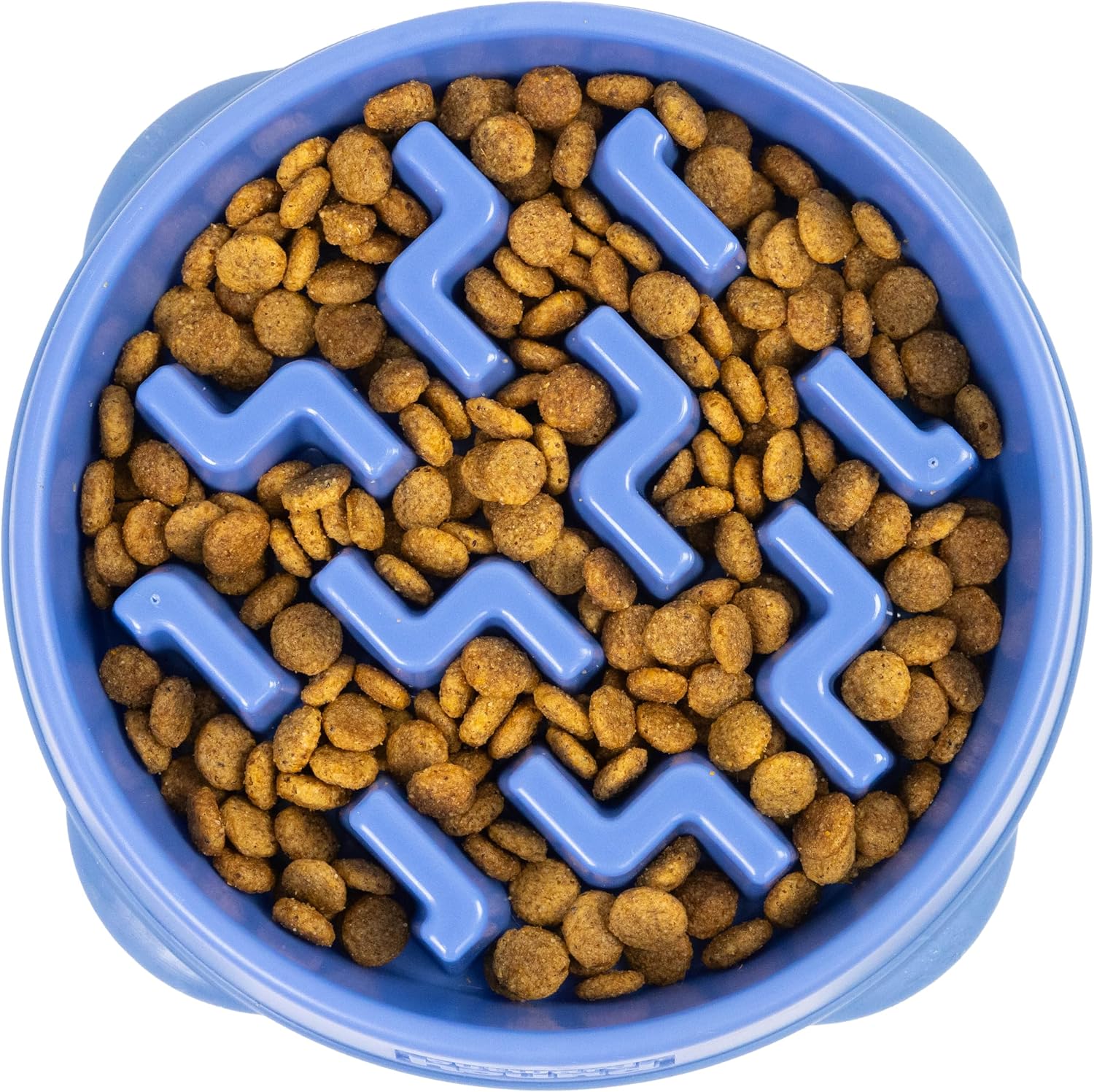
This is the bowl the whole category is measured against, and with more than a hundred and thirty thousand reviews at 4.6 stars it has the largest evidence base of any product we have looked at in any pet category. What it gets right is the ridge geometry: the channels are deep enough to genuinely slow a gulper but rounded and wide enough that a dog can get its tongue into them without frustration, which is the balance most cheap imitations miss. It comes in three sizes and several maze patterns, so you can match difficulty to the dog rather than buying whatever arrives. The non-slip base holds on tile until a large determined dog decides otherwise. Two honest limitations: it is plastic, so it will scratch over a year or two of dishwasher cycles and should then be replaced, and the tighter patterns pack with wet food and need a brush rather than a rinse.
Pros
- Ridge depth genuinely slows eating without frustrating the dog
- Three sizes and several maze patterns, so difficulty can match the dog
- Vastly the largest review base in the category, so failure modes are well known
- Top rack dishwasher safe and inexpensive to replace when it scratches
Cons
- Plastic scratches over time and should be replaced rather than scrubbed
- A big determined dog can still flip it off tile
Best budget
UPSKY Slow Feeder Dog Bowl
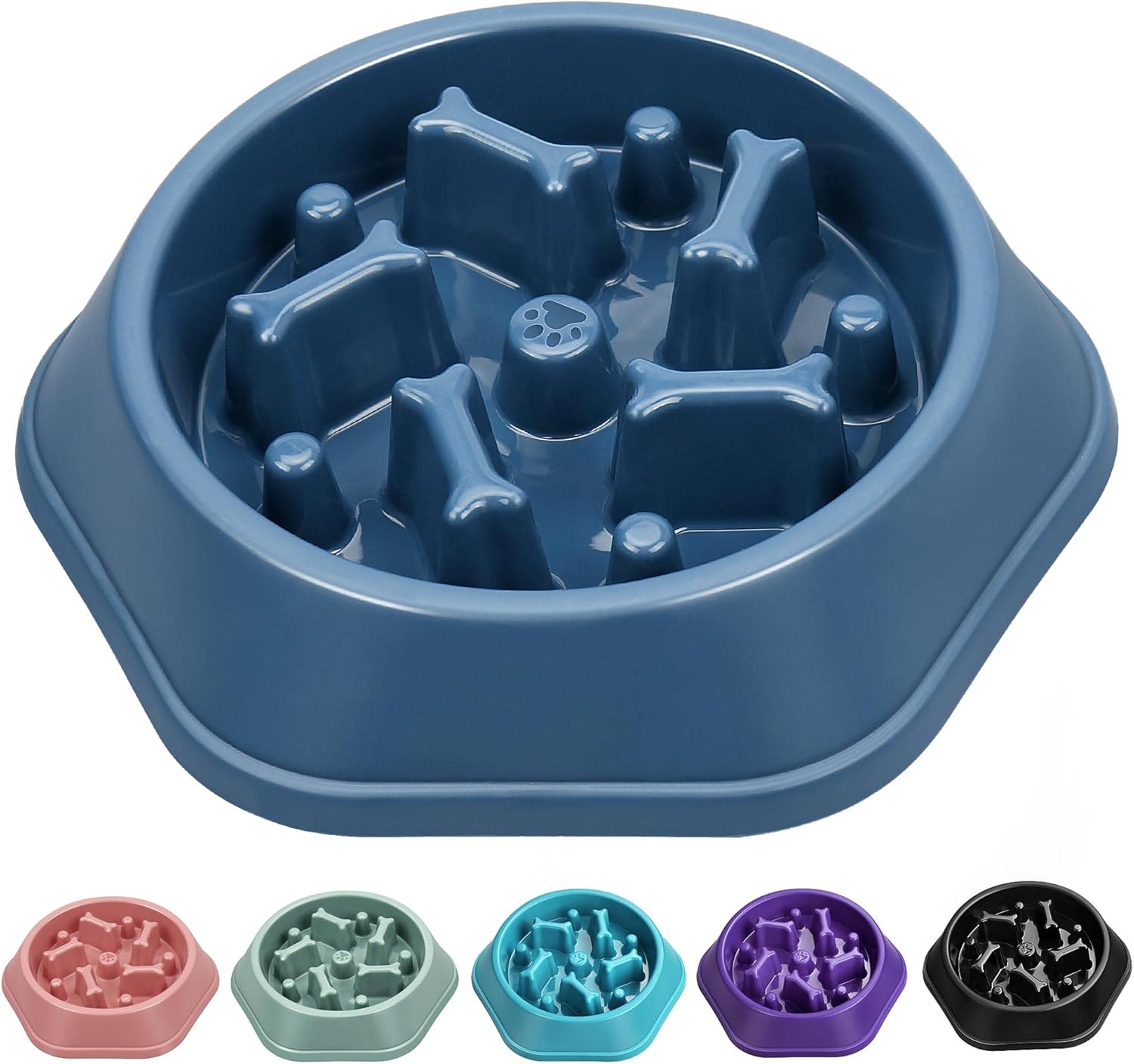
The UPSKY is the sensible pick when you are not yet sure a slow feeder will change anything and do not want to spend to find out. The maze is a shallower, more forgiving pattern than the Outward Hound, which makes it a better first bowl for a dog that gives up easily and a worse one for a committed hoover. At 4.5 stars across more than five thousand reviews it is well proven at its price, and the wide flat base resists tipping better than the shape suggests. Where it gives ground is material quality: the plastic is thinner, it goes cloudy sooner in a hot dishwasher, and owners report the non-slip ring perishing before the bowl does. Treat it as a twelve to eighteen month item rather than a permanent one and it is good value.
Pros
- Cheapest bowl here that we would still recommend
- Shallower maze suits dogs that get frustrated by aggressive patterns
- Wide flat base is harder to tip than it looks
- Well proven across several thousand reviews
Cons
- Thinner plastic goes cloudy faster in the dishwasher
- The non-slip ring tends to perish before the bowl wears out
Best adjustable difficulty
Puzzle Feeder Slow Feeder Bowl with Removable Inserts
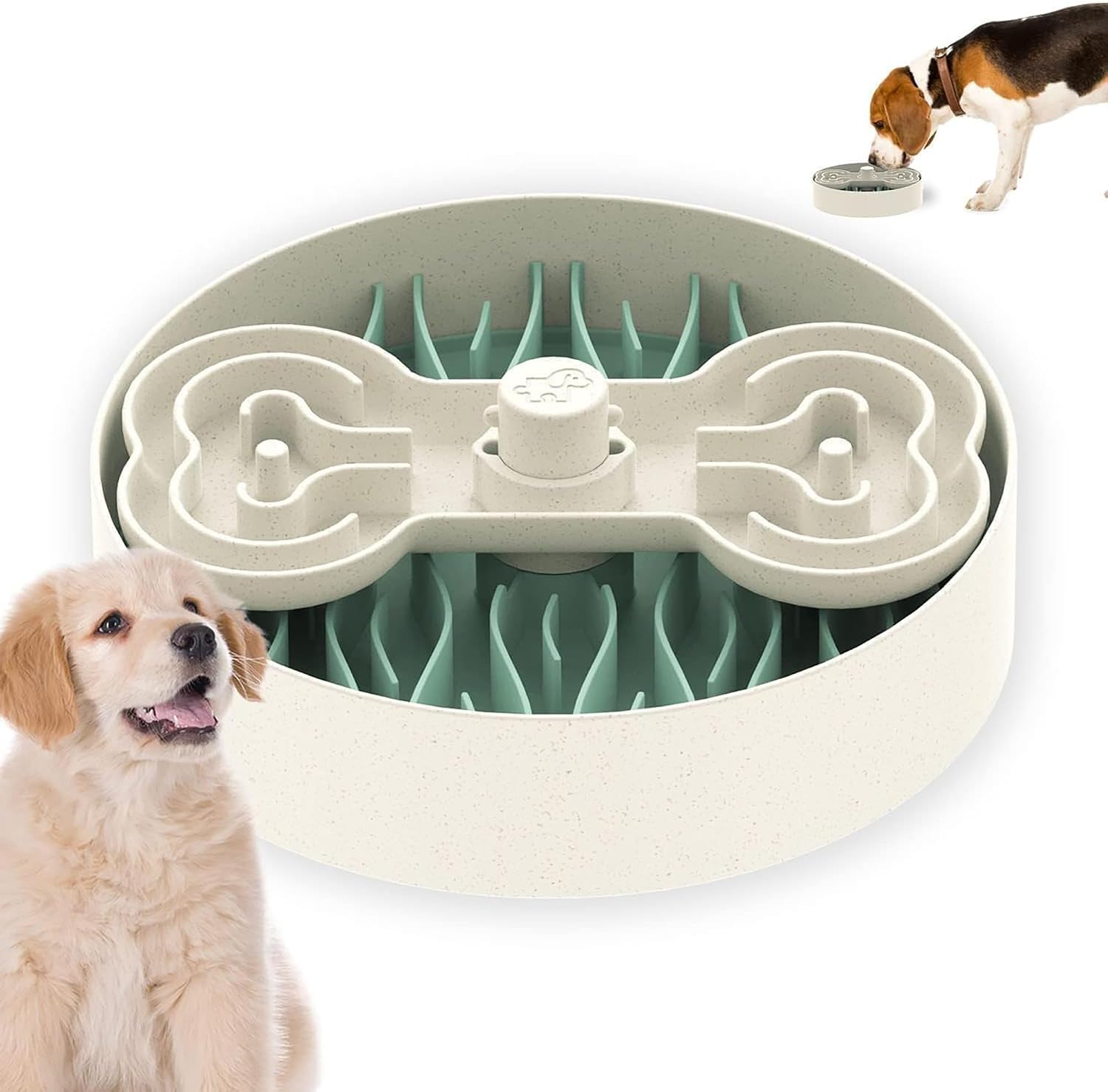
The removable insert is the idea every other bowl here is missing. You start with the puzzle pieces out, which makes it an ordinary bowl, then add them one at a time as the dog gets used to the game. For an anxious dog, a rescue with food guarding history, or a puppy that has never met an obstacle at dinner, that gradient matters far more than the maximum difficulty a bowl can reach. It also solves the cleaning problem outright: the inserts lift out, so there are no permanently narrow channels for wet food to pack into, and it scores best here on cleaning as a result. It is sized for large dogs, which makes it the wrong shape for a cat or a toy breed, and at a few hundred reviews the long-term picture is thinner than the Outward Hound's. The concept is good enough that we would still buy it.
Pros
- Removable inserts let you dial difficulty up as the dog adapts
- Nothing to pack with wet food, so it is the easiest here to clean properly
- Non-slip base and enough width for a large breed
- Doubles as a normal bowl on days you want it to
Cons
- Sized for large dogs, so it is wrong for cats and toy breeds
- A few hundred reviews rather than thousands, so durability is provisional
Best for large breeds
Neater Pet Brands Neater Slow Feeder
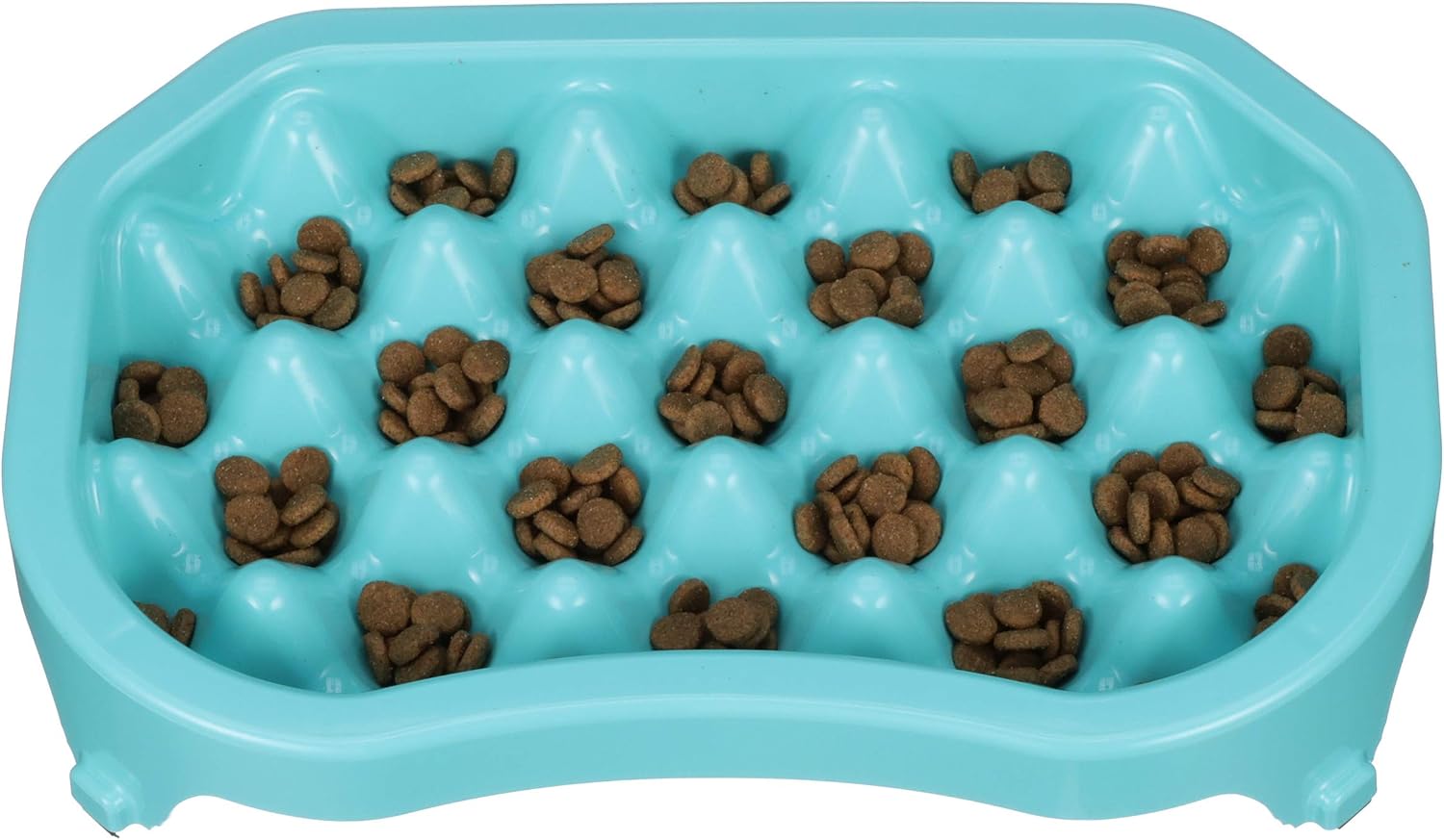
Most slow feeders top out around four cups, which is a problem if you feed a Great Dane or a working dog on a big ration. The Neater holds six, splitting it across fourteen separate compartments rather than one continuous maze, and that compartment approach is meaningfully different in practice: a dog cannot get a run at it and sweep a channel clean in one pass, which is exactly what large dogs learn to do with maze bowls. The base is broad with rubber feet and it is one of the few bowls here that a big dog genuinely cannot pick up. Against it: fourteen compartments is fourteen things to clean, and the buy box could not be confirmed on the day we checked, so verify availability before you commit. At 4.5 stars it is well regarded, though on a much smaller review base than our top two.
Pros
- Six cup capacity, roughly double the usual slow feeder
- Fourteen compartments stop a big dog sweeping the bowl in one pass
- Broad rubber-footed base that a large dog cannot lift
- Genuinely designed for the size of dog that most needs slowing down
Cons
- Fourteen compartments take longer to clean than a continuous maze
- Buy box could not be confirmed at the time of writing, so check availability
Best for cats
Catit Senses 2.0 Digger Interactive Slow Feeder
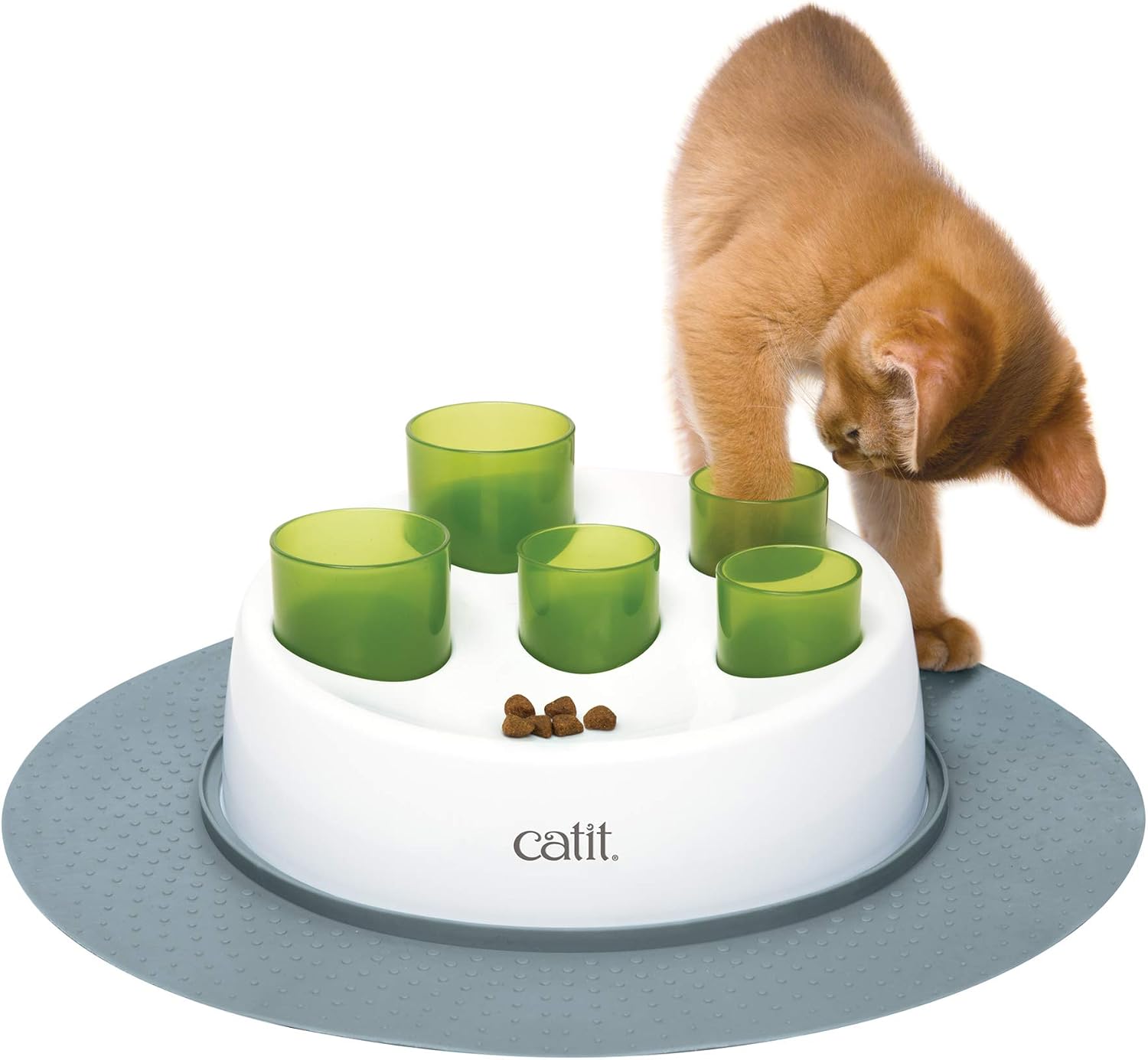
A maze bowl designed for a dog's muzzle is the wrong tool for a cat, and this is what to buy instead. The Digger is a set of upright tubes of differing heights that a cat has to paw kibble out of, which works with a cat's natural behaviour rather than against it and turns a ten second meal into a genuine activity. For an indoor cat that eats out of boredom, that enrichment is arguably worth more than the slowing itself. At 4.3 stars across fifteen thousand reviews it is the established option in a category with very few real competitors. Cleaning is its weak point and the reason it does not score higher: the tubes are deep and narrow, so it is a bottle brush job rather than a dishwasher one, and it is strictly a dry food product. Do not try it with wet.
Pros
- Works with a cat's pawing instinct instead of fighting its face shape
- Real enrichment for an indoor cat that eats out of boredom
- Stable base that a cat cannot easily tip
- Well established, with fifteen thousand reviews behind it
Cons
- Deep narrow tubes need a bottle brush, not a dishwasher
- Dry food only
Frequently asked questions
Do slow feeder bowls prevent bloat?
The honest answer is that they may reduce one risk factor, and that is not the same as preventing bloat. Gastric dilatation-volvulus is a genuine emergency, and the large epidemiological study most often cited on it, Glickman and colleagues in the Journal of the American Veterinary Medical Association in 2000, identified fast eating as one of several factors associated with higher risk in large and giant breed dogs, alongside chest conformation, age and a raised feeding position. A bowl that slows eating addresses one item on that list. It does not make a deep-chested dog safe, and no bowl should be sold as if it does. If your dog is a high-risk breed, that is a conversation to have with your vet, including whether a preventative gastropexy is appropriate.
What does a slow feeder definitely help with?
Two things, well supported by everyday experience rather than by trials. Dogs that inhale dry food frequently regurgitate it whole a few minutes later, and slowing the meal usually stops that. And a meal that takes ten minutes instead of ninety seconds is genuinely enriching for a bored dog, which is the same reason puzzle feeders exist. Those are good reasons to buy one on their own.
How do I clean a slow feeder properly?
Top rack of the dishwasher for every bowl on this page, and check the channels afterwards, because wet food packs into the tight corners of the more aggressive maze patterns and the dishwasher jet does not always reach it. If you feed wet or raw, run a bottle brush through the channels rather than trusting the machine. Plastic that has gone cloudy or scratched is worth replacing rather than scrubbing harder, since scratches hold bacteria and are a known contributor to canine chin acne.
My dog just picks the bowl up and tips it out. What now?
That is the most common failure and it is a design problem, not a training problem. You need weight, a non-slip base, or both, and for a determined dog the answer is usually a bowl that sits inside a heavier frame, or a slow feeder insert dropped into a stainless bowl the dog already cannot lift. The Neater below holds six cups and is broad enough that most dogs cannot get a jaw under the rim. Failing that, feed on a rubber mat in a corner where the bowl cannot be dragged.
Are slow feeders suitable for flat-faced breeds?
With care. Pugs, Frenchies and Persians cannot reach into deep narrow channels, so a maze designed for a Labrador just means a frustrated dog and a lot of food left behind. Look for shallow, wide patterns with rounded ridges rather than tall thin fins, start with the easiest pattern available, and watch the first few meals. If your dog gives up rather than slows down, the bowl is wrong for that face shape.