Dog Ramp vs Stairs (2026): Which Does Your Dog Need?
Ramp or steps for a dog that has stopped jumping: which suits stiff joints and long backs, why the gradient decides it, and what makes a dog refuse either one.
Both work. Neither works if the dog will not walk on it, and that is where this money is usually lost: the aid arrives, the dog keeps jumping, and the thing ends up folded behind a door. So the useful question is not which is gentler in principle, but which one your dog will use, at the height you need, in the space you have.
First, rule out the thing that is not a shopping problem
A dog that could make the bed last month and cannot today has not aged overnight. Sudden reluctance to jump is one of the ways spinal and joint pain first shows itself, and buying a ramp that week turns a vet visit into a purchase, delaying a diagnosis where delay does real harm. Book the appointment, then buy the aid.
The same applies after surgery. A recovering dog has a rehabilitation plan, and what it is allowed to climb belongs in that plan rather than in a product description.
Gear like this removes a jump. It does not treat arthritis, hip dysplasia or disc disease, and no ramp on the market does.
Ramps: the gradient is the whole product
A ramp is the gentler option because it is the only one that removes the impact rather than dividing it. The AKC makes that point specifically for the long-backed breeds, dachshunds, corgis and basset hounds, where the concern is jarring a spine rather than loading a joint.
But “ramp” describes a shape, not a difficulty, and the difficulty is arithmetic: the same ramp is an easy walk at a sofa and a climb at a tall bed. That is why two owners buy one product and file opposite reviews, and why adjustable height is worth paying for. Start the dog low, where it will accept the surface, and raise it as confidence builds.
Length decides whether a ramp gets used. Height is what everyone shops on. Buy for both.
Stairs: the problem is coming down
Steps ask for less floor space, which for most households is the real constraint, and small dogs often take to them faster because climbing is a motion they already understand.
The catch is the direction nobody tests in the shop. Going up is a push; going down is a controlled drop onto the front legs, repeated on every step, and descending is where an unsteady dog hesitates or bails off the side. That is the argument for rails, and the argument against steps for a dog with a diagnosed back problem, where those small repeated impacts are the thing you were trying to remove.
Foam or frame is the other fork. Foam is quieter, softer and has nothing to rattle, but caps out around 60 lb. A frame carries a big dog and takes up less room folded, at the cost of treads that wear and feet that creep on hard floors.
Choosing, in one line each
Diagnosed joint or back trouble, a long-backed breed, or a dog over about 60 lb: ramp, and buy enough length for the height.
A small or medium dog with no diagnosis, a low sofa, and not much floor to spare: steps, in foam if the dog is little, and sized from our best dog stairs for a couch roundup rather than by step count.
A dog that is nervous rather than sore: whichever you can lay flat on the floor and introduce over a week. Confidence decides this, not geometry.
The car is a separate purchase. At tailgate height only real length keeps the climb walkable, so buy a ramp built for it rather than stretching an indoor one to reach.
Plenty of households end up with both, steps at the sofa and a ramp at the bed.
What the dog climbs onto matters as much as how it gets there: stiff joints landing on a thin mattress have gained little, which our best dog beds for senior dogs and best orthopedic dog beds roundups cover. For the car the height roughly doubles, making a ramp close to compulsory for a big dog alongside the restraints in our dog seat belts and car restraints guide. And if you are still lifting the dog, a correctly measured harness is what makes that lift safe for both of you.
How we test
Every pick is scored on the same five criteria and cross-checked against real owner feedback - so the ranking reflects how a product holds up after six months in a real house with a real animal, not its spec sheet.
Build
Materials and construction: pump and motor quality, whether plastics are food safe, and how well the thing is actually put together.
Cleaning
How much work it is to keep hygienic. Dishwasher-safe parts, how many pieces it breaks into, and whether biofilm can hide in a corner you cannot reach.
Durability
Whether it survives months of daily use, chewing, scratching and repeated washing without the motor dying or the seals failing.
Pet fit
Whether animals will actually use it: size range, whisker clearance, height, and how the design suits nervous or senior pets.
Value
What you get for the price, including the running cost of filters, liners and other consumables it locks you into.
Best ramp
SweetBin Wooden Adjustable Dog Ramp for Bed and Couch
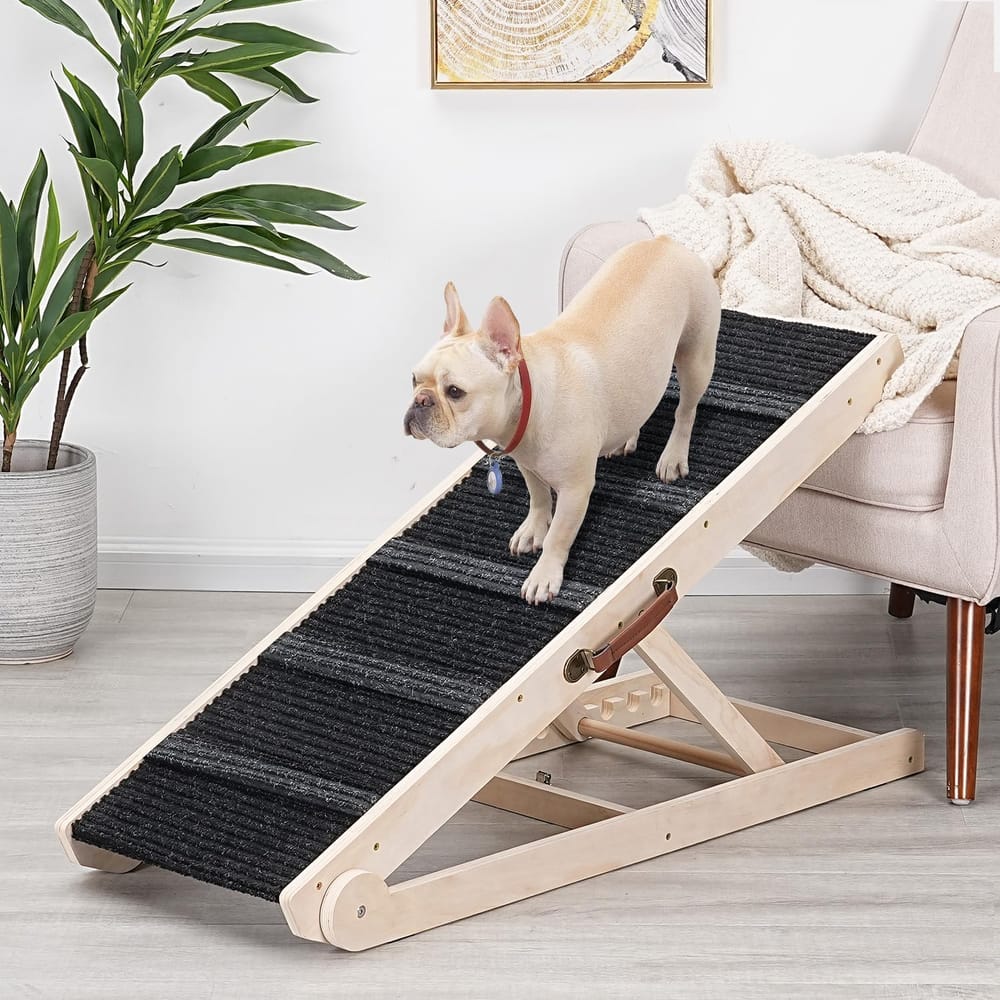
The adjustability is the reason this is the ramp pick rather than a nicety. Six settings from 12 to 24 inches let you start low, let the dog learn the surface at a gradient it will accept, and raise it week by week, which is exactly the introduction the AKC and PetMD describe and which a fixed ramp makes impossible. The frame is furniture-grade ply rather than the moulded plastic common at this price, it folds flat, and the traction mat is deep enough that claws find it rather than skating. Rated to 200 lb. The mat is the weak point: glued rather than removable, so a muddy dog means scrubbing in place.
Pros
- Six heights from 12 to 24 inches, so the gradient can start gentle
- Reaches a tall bed, which most indoor ramps do not
- Furniture-grade ply frame, folds flat for storage
- Deep traction mat rather than a slick moulded surface
Cons
- Traction mat is fixed, so cleaning means scrubbing in place
- Needs real floor space when deployed at full height
Best steps
PetSafe CozyUp Folding Dog Stairs, 25 Inch
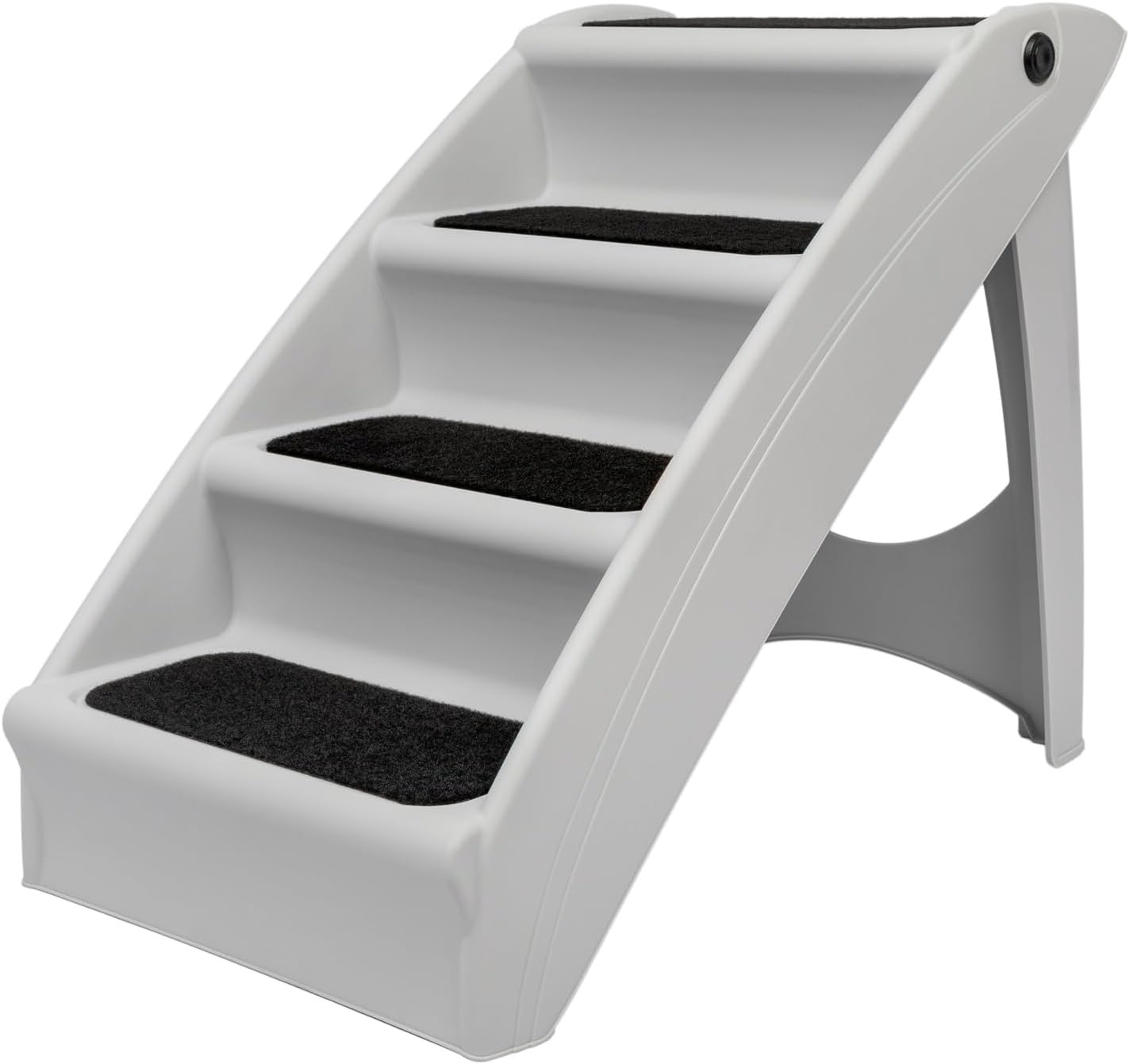
The steps to buy if the dog is too big for foam, which is most of the reason to pick steps over a ramp at all. Four steps to 25 inches reach a tall bed, the 200 lb rating covers a labrador against the 60 lb ceiling typical of foam, and the side rails matter more than they sound for a dog that is unsteady coming down. Two caveats keep it at 4.1 stars across thirty thousand reviews: the fabric treads wear and loosen at the step edge where the paw lands hardest, and the frame creeps on hard floors. Put it on carpet or against a wall.
Pros
- 200 lb rating, so it suits a large dog rather than only a small one
- Reaches 25 inches, tall enough for a high bed
- Side rails give an unsteady dog something to lean into
- Folds flat in one motion for storage or travel
Cons
- Fabric treads wear and loosen at the step edge over time
- Creeps on hard floors unless it is braced against something
Best for a small senior dog
EHEYCIGA 5-Step Foam Dog Stairs, 25 Inch
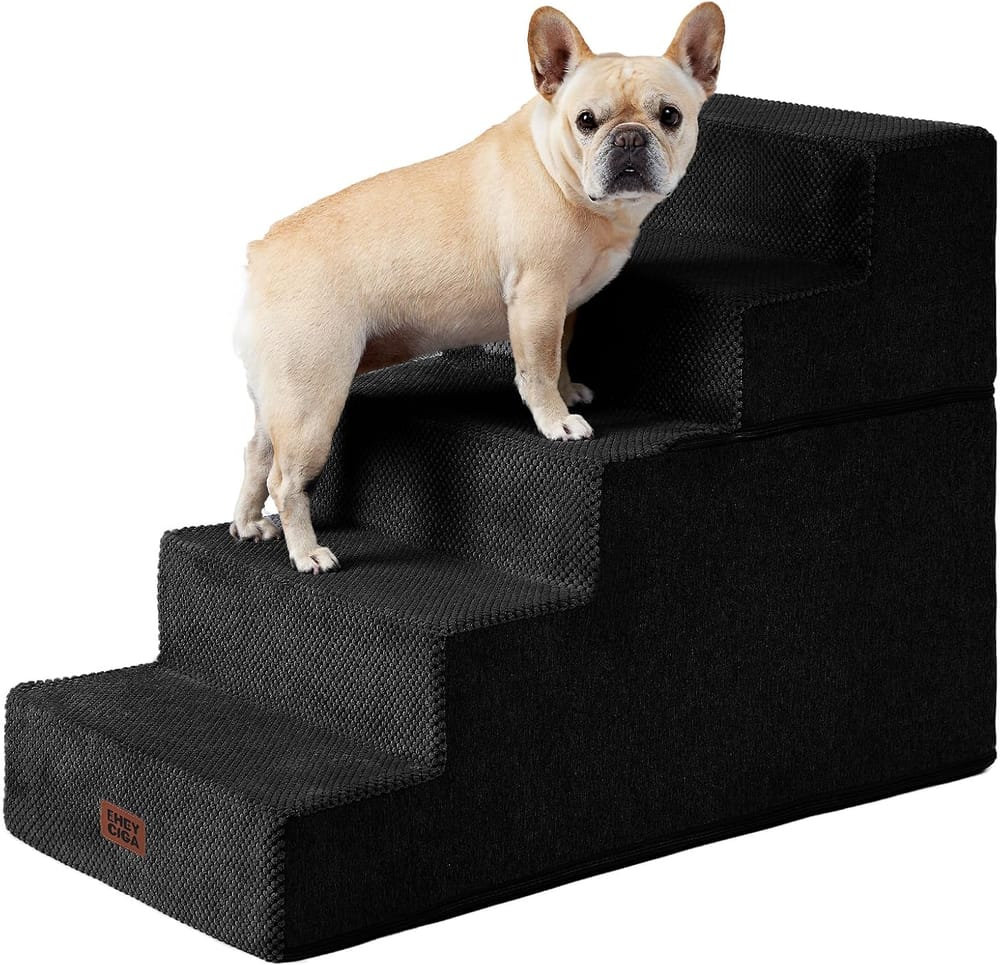
The best-rated aid on this page at 4.4 stars across eleven thousand reviews, and the one to buy for a small, stiff, easily spooked dog. Foam changes the experience rather than the geometry: nothing rattles, nothing creeps, and a dog that mistrusts a frame underfoot will commit to this when it will not commit to steps that move. Five treads to 25 inches means shallow risers, which is what an arthritic dog needs going down. The cover unzips and washes. Foam is also the limit: it compresses under weight, so check the stated capacity against your dog first, and expect the top tread to soften first because that is where the push-off lands.
Pros
- Best-rated option here, on a large review base
- Five shallow treads rather than four deep ones
- Silent and stable, with no frame to creep or rattle
- Removable, washable cover
Cons
- Foam compresses, so capacity is well below a framed design
- The top tread softens first under daily use
Best for a low sofa
PETMAKER 3-Step Foam Pet Stairs
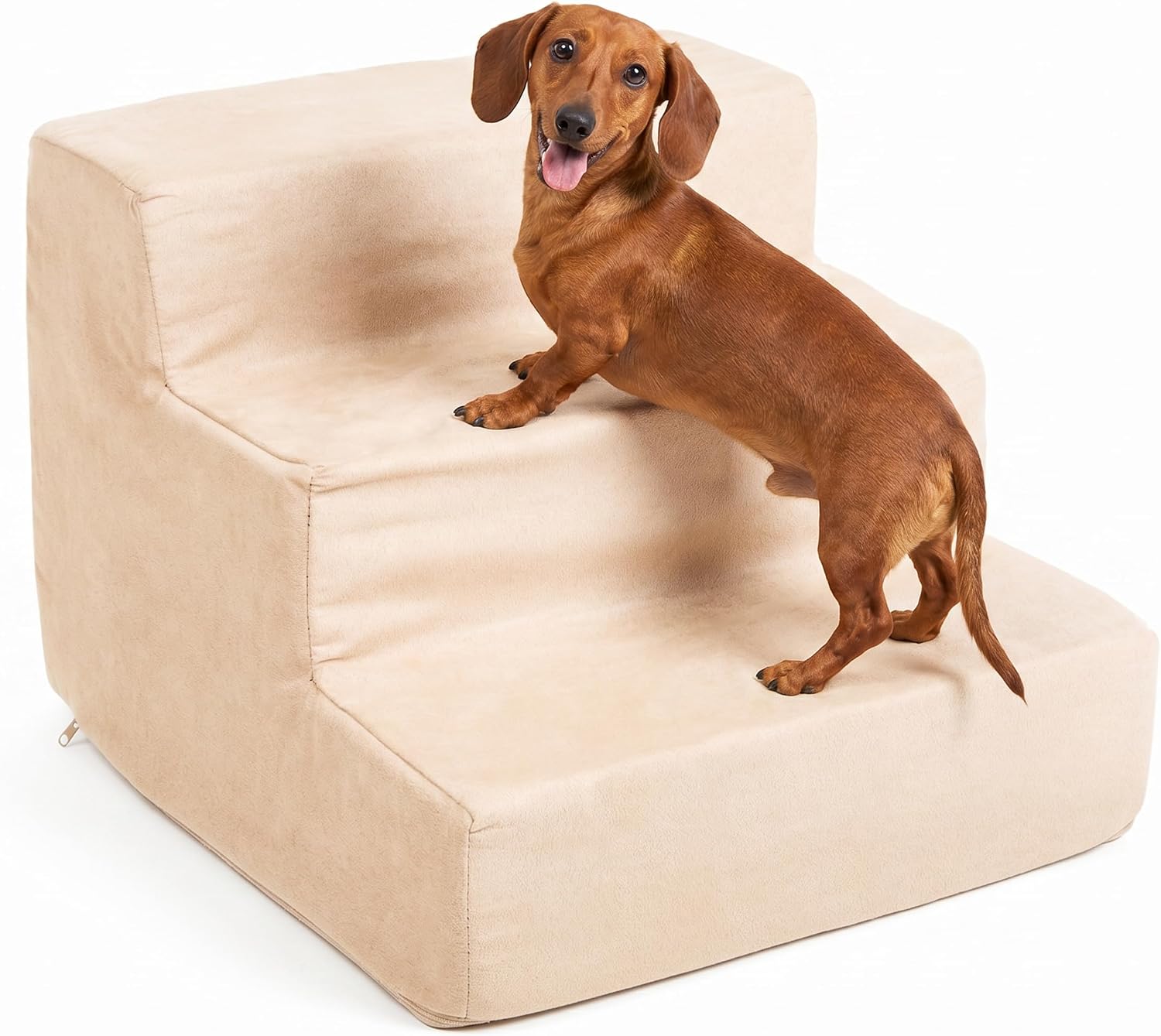
Three steps is the right answer for a sofa and the wrong one for a bed, and buying by step count rather than by measuring is the most common sizing mistake in this category. Where it beats everything else here is cleaning: the microfibre cover is zippered and comes off for the machine, which matters for an older dog far more than the spec sheet suggests, because incontinence is what actually ends the life of a set of steps. It is the cheapest thing we would recommend. The trade is reach, at roughly sofa height only, and foam that a large dog will flatten.
Pros
- Zippered cover machine-washes, unlike most fixed treads
- Cheapest aid here that still clears our quality floor
- Light enough to move between rooms one-handed
Cons
- Sofa height only, nowhere near a tall bed
- Foam flattens under a large dog
Best for the car
PetSafe Happy Ride Extra-Long Telescoping Dog Ramp
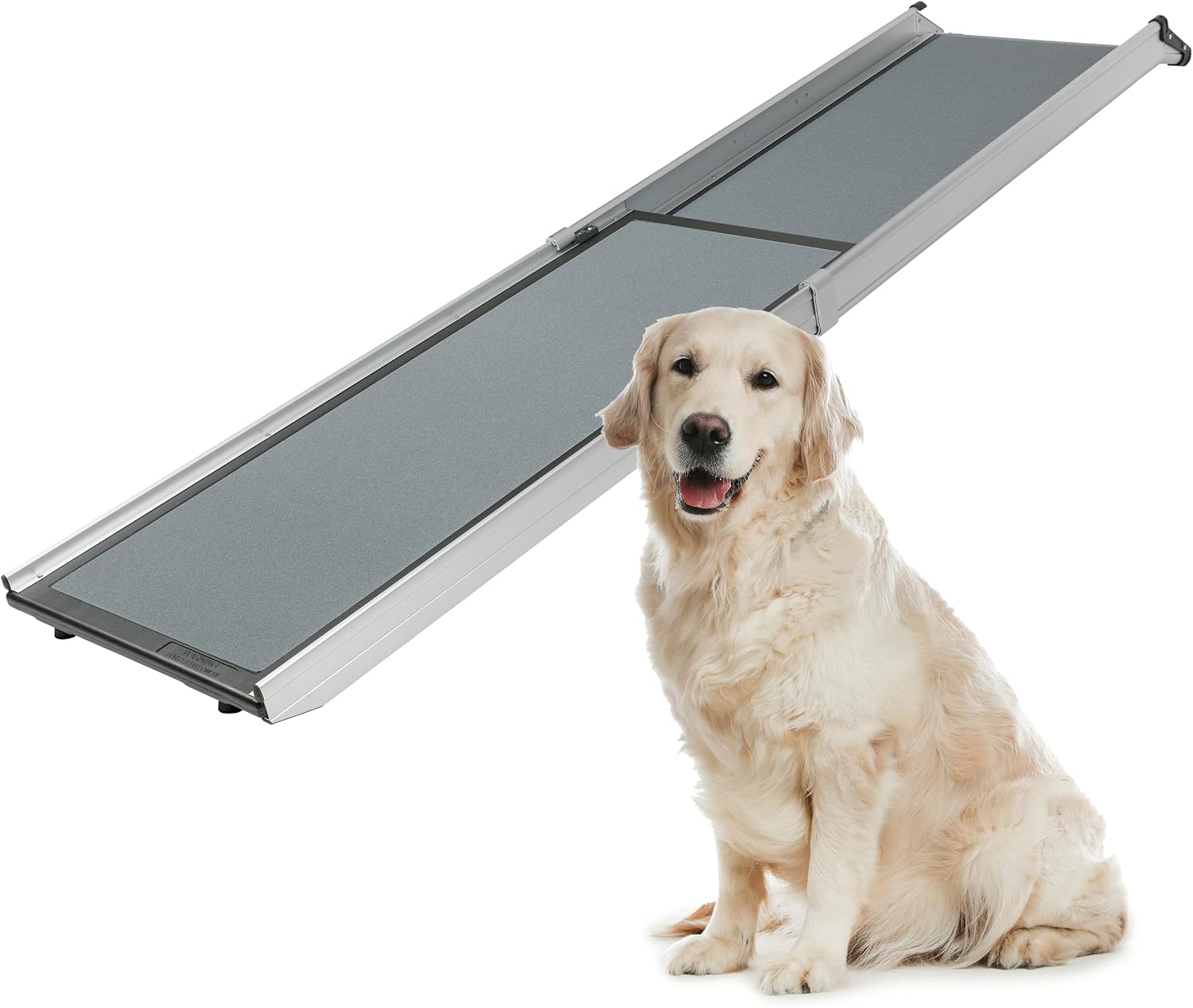
A tailgate is roughly double sofa height, and length is the only thing that keeps that climb walkable, which is why an indoor ramp does not transfer to the car. This telescopes to 87 inches, the longest here by a wide margin, and that run is the entire product. The aluminium frame and high-traction surface are a clear tier above the wooden indoor ramps, it collapses to a carryable size, and the side rails stop a dog stepping off mid-way, which is the specific failure that frightens a dog off ramps permanently. It is the most expensive pick here and heavy enough that lifting it daily gets old.
Pros
- Telescopes to 87 inches, the gentlest climb here at car height
- Aluminium frame, high-traction surface, side rails
- Collapses down for storage in the boot
Cons
- Most expensive option on this page
- Heavy to deploy and stow every single day
Also worth considering
Strong, well-reviewed products that just missed our ranked list - worth a look if the picks above aren't quite right for you.
- PetSafe Happy Ride Folding Dog Ramp - The lighter, cheaper car ramp at 62 inches and 150 lb. Worth it over the telescoping model if you lift it in and out daily and your dog is well under that limit.
- Adjustable Folding Wooden Dog Ramp with Safety Rails - Reaches 23.5 inches with a rubber walking surface instead of carpet, which hoses clean. Rated 4.0 on a much smaller review base than our ramp pick, so it is a second choice rather than a rival.
Frequently asked questions
Will my dog actually use it?
Not on day one, and that is the most common reason these end up in a garage. The AKC and PetMD describe the same approach: let the dog investigate it first, lure it across with a treat while the ramp or steps lie flat on the floor, then raise them to working height. Reward each step, and never push, pull or scold a dog up one. A fright on the first attempt is far harder to undo than a slow start. Budget a week.
Which is better for a dachshund or another long-backed breed?
A ramp, on the reasoning the AKC gives for breeds prone to disc problems: it removes the jarring rather than breaking it into smaller pieces. Corgis and basset hounds are in the same group. This is also a risk profile serious enough that if your dog has ever had back pain, weakness or a diagnosis, the choice belongs with your vet before a shopping page.
How much floor space does a ramp need?
More than people expect, which is what sends most of them back. Height and length trade directly: a 40 inch ramp reaching a 24 inch bed climbs 24 inches over 40 inches of run, steep enough that plenty of dogs decline it. At an 18 inch sofa the same ramp is far gentler. Measure the furniture first, buy length to suit it, and check it still leaves a walkway when deployed.
Can one aid cover the bed and the car?
Rarely well. A tailgate is roughly twice the height of a sofa, so an indoor ramp sized for the couch cannot reach it at any sensible angle, and a telescoping car ramp is too long to leave standing in a bedroom. Households needing both usually end up with one at each.