Why Cats Prefer Running Water (And What To Do If Yours Doesn't)
Why cats favour moving water, why some ignore a fountain entirely, and the practical steps that get a reluctant cat drinking more.
Cats are descended from desert animals that got most of their water from prey rather than from drinking. That ancestry left them with a weak thirst drive relative to dogs, and with instincts about water sources that make perfect sense in a dry landscape and look eccentric in a kitchen.
Moving water reads as safe water
In the wild, still water sits and stagnates. Moving water is running from somewhere, which means it is less likely to be contaminated. A cat’s preference for a dripping tap over a full bowl is not fussiness, it is a reasonable heuristic inherited from animals for whom the difference mattered.
Movement also aerates, which changes the taste, and it keeps the surface from developing the film that forms on standing water within a day. If you have ever noticed a cat drink enthusiastically from a puddle and ignore a fresh bowl indoors, this is why.
Whiskers, and the bowl nobody suspects
The second reason has nothing to do with the water. A narrow, deep bowl presses on a cat’s whiskers while it drinks, and plenty of cats will not tolerate that sensation. They approach, hesitate, and walk away, which owners read as rejecting the water.
The test is simple: offer the same water in a wide, shallow dish. If the cat drinks readily from that, the problem was never the water. This is also why every fountain we rank has a bowl wide enough to keep whiskers clear of the sides.
Position matters as much as design
Cats avoid drinking next to where they eat, and avoid it strongly near a litter tray. Both are instincts about contamination, and both are routinely defeated by kitchen layouts that put the food bowl, water bowl and tray in one tidy row.
Separate them. Put water somewhere the cat can drink with its back to a wall and a view of the room, because a cat that feels exposed at a water source drinks less and leaves sooner. Multiple water stations in different rooms work better than one perfect one.
If the fountain gets ignored
Give it two weeks with the old bowl still available. Run it on the lowest flow. Move it before you replace it.
And accept that a minority of cats simply never take to one. If yours is among them, wet food is the more reliable route to hydration, and it always was: a cat on wet food takes most of its water with its meals. Our guide to slow feeder bowls includes a cat-specific pick if the meal itself needs slowing down.
If you do buy a fountain, the pump is what eventually fails and the filters are the cost nobody quotes. Our best cat water fountains roundup ranks on exactly those two things, and the filters explainer does the annual arithmetic. Placement is the other half of this, and it is where a cord becomes the constraint: if the spot your cat prefers has no socket near it, our best battery operated cat water fountains guide covers the cordless options.
One boundary worth stating plainly: a noticeable change in how much your cat drinks, in either direction, is a reason to call a vet rather than to buy a fountain. Increased thirst in particular is one of the more common early signs of illness in older cats. We review products; we are not veterinarians.
How we test
Every pick is scored on the same five criteria and cross-checked against real owner feedback - so the ranking reflects how a product holds up after six months in a real house with a real animal, not its spec sheet.
Build
Materials and construction: pump and motor quality, whether plastics are food safe, and how well the thing is actually put together.
Cleaning
How much work it is to keep hygienic. Dishwasher-safe parts, how many pieces it breaks into, and whether biofilm can hide in a corner you cannot reach.
Durability
Whether it survives months of daily use, chewing, scratching and repeated washing without the motor dying or the seals failing.
Pet fit
Whether animals will actually use it: size range, whisker clearance, height, and how the design suits nervous or senior pets.
Value
What you get for the price, including the running cost of filters, liners and other consumables it locks you into.
Best first fountain
Catit Stainless Steel Flower Fountain
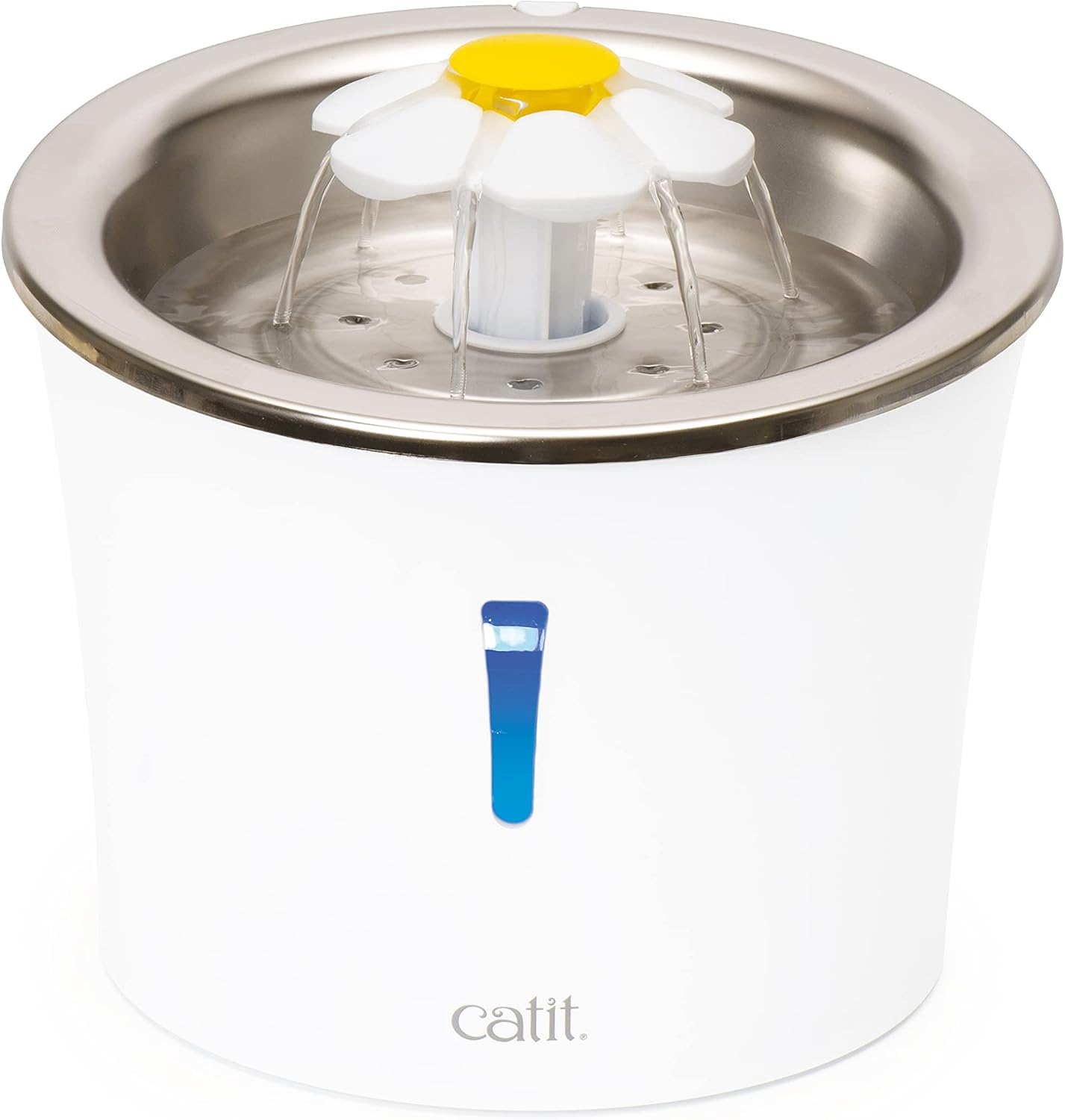
If you are testing whether your cat will take to moving water at all, this is the one to test with. Three flow settings matter more here than any other feature, because the commonest reason a cat rejects a fountain is that it splashes: start on the gentlest and work up only if your cat is unbothered. It is the cheapest option we recommend without caveats, and with close to fifty thousand reviews the failure modes are thoroughly documented. The stainless top fixes the scratched-plastic problem of the original. The reservoir is still plastic and the filters are proprietary, so the running cost is higher than the sticker suggests.
Pros
- Three flow settings, the feature that decides acceptance for nervous cats
- Cheapest fountain we recommend without reservations
- Stainless top avoids the scratched-plastic biofilm problem
- Enormous review base, so nothing about it is a surprise
Cons
- Plastic reservoir under the steel top plate
- Proprietary filters every three to four weeks
Frequently asked questions
Why does my cat drink from the tap but ignore its bowl?
Moving water is fresher by definition, and a cat can tell. Still water in a bowl collects dust, hair and bacteria within hours, and it takes on the taste of whatever the bowl is made of. A running tap has none of that. There is also a positioning element people miss: a tap is usually at counter height, away from the food bowl, in a spot the cat can watch the room from. All three of those matter as much as the movement itself.
How much water should a cat drink a day?
Roughly 50ml per kilogram of body weight across all sources, so about 200ml a day for a 4kg cat. A cat on wet food gets much of that from its meals and may drink very little from a bowl, which is normal. What matters is not the absolute figure but a change: a cat that suddenly drinks noticeably more, or noticeably less, is telling you something and it is a vet conversation, not a shopping one.
My cat ignores the new fountain. What now?
Leave the old bowl out and give it a fortnight. Run the fountain on its lowest flow setting, because splashing puts off more cats than it attracts, and place it away from the food bowl and away from the litter tray. If it is still unused after two weeks, try moving it rather than replacing it: position defeats more fountains than design does.
Does a fountain prevent kidney or urinary problems?
No, and be wary of any listing that suggests it does. Better hydration is generally good for cats and is often recommended alongside veterinary treatment for urinary and kidney conditions, but a fountain is a way of encouraging an already-healthy cat to drink a bit more. It does not treat or prevent disease. Anything involving straining, blood, or a change in drinking habits is a vet matter.